





Fiji and Aotearoa / New Zealand have signed a new agreement to strengthen food security, farmer resilience and climate-smart agriculture across Fiji.
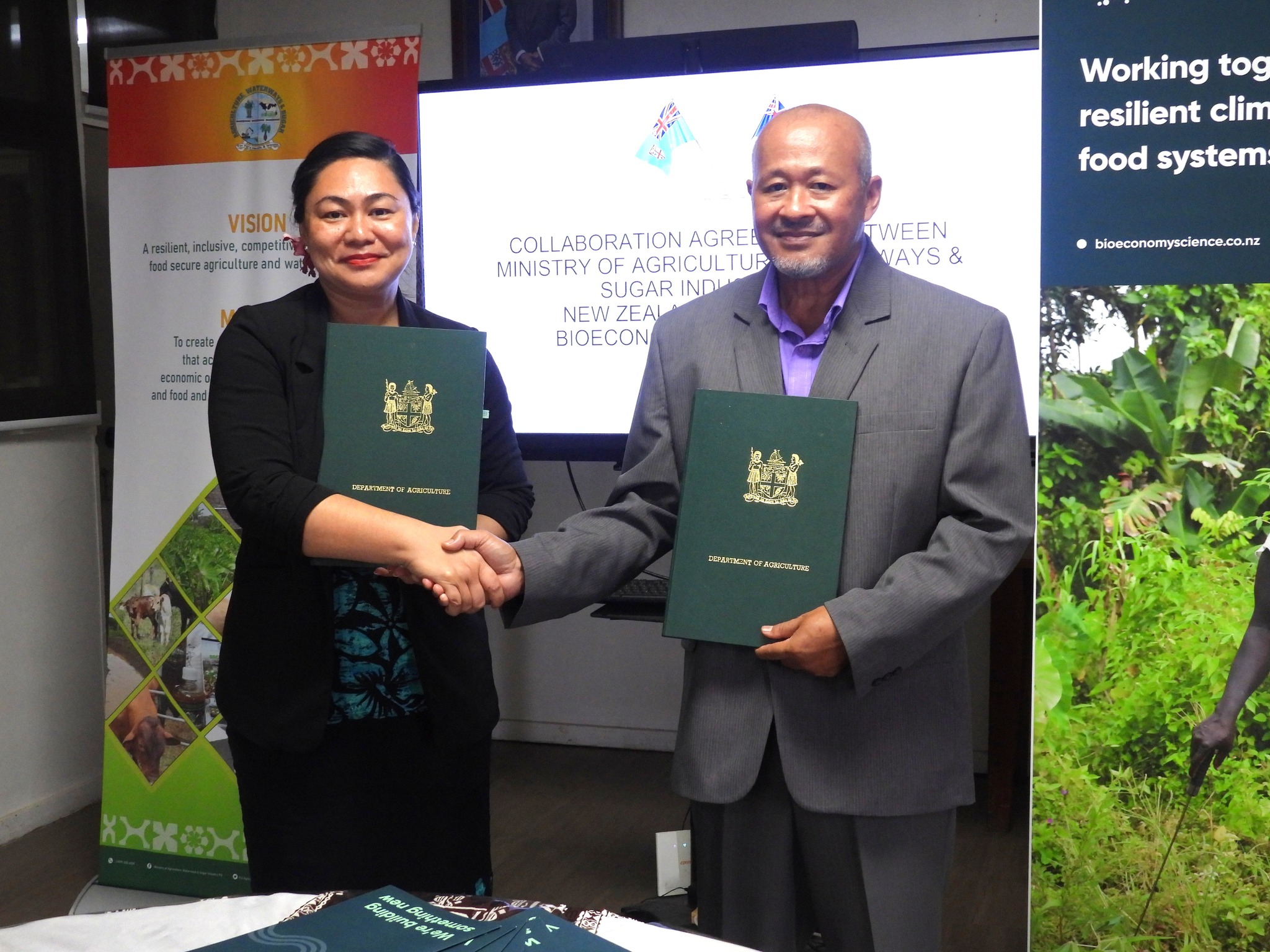
The Fijian Ministry of Agriculture, Waterways and Sugar Industry formalised the partnership with the New Zealand Institute for Bioeconomy Science Limited at the ministry's headquarters in Raiwaqa.
The agreement was signed by Permanent Secretary for Agriculture, Waterways and Sugar Industry Dr Andrew Tukana and Head of International Development for the Plant & Food Research Group at the Bioeconomy Science Institute of New Zealand Dr Seeseei Molimau-Samasoni.
The collaboration sits under the Climate-Smart Pacific Food Systems Implementation Programme, a regional initiative supported by the Government of New Zealand through the New Zealand Ministry of Foreign Affairs and Trade.
The program aims to strengthen food systems, improve farmer resilience and promote sustainable agricultural practices across the Pacific.
Dr Tukana welcomed the partnership and acknowledged New Zealand's continued support for Fiji and the wider region.
He said the partnership would support food security and sustainable farming.
"The Ministry recognises the importance of this partnership in supporting food and nutrition security, strengthening farmer resilience, and promoting sustainable and healthier farming systems for Fiji," Dr Tukana said.
Climate change continues to affect farmers and food production systems across the Pacific, with the program designed to support practical responses at community level.
The initiative will include research trials, farmer training and the testing of climate-resilient farming practices.
It will focus on improving food production, soil health, pest and disease management and reducing post-harvest losses.
Farmers, communities and agricultural stakeholders will be involved in identifying solutions to strengthen food security and improve resilience to climate-related challenges.
Dr Tukana said the work would be done directly with farmers and communities.
"Through this partnership, we will work closely with farmers and communities to improve productivity and yields, strengthen resilience to climate shocks, and support sustainable agricultural practices," he said.
The ministry will lead implementation in Fiji through technical guidance and support from its Research and Extension Divisions.
Under the agreement, the ministry will provide local leadership, technical expertise, farmer networks and coordination support.
The Bioeconomy Science Institute of New Zealand will contribute scientific research, innovation and technical assistance.
Activities in Fiji will be coordinated through the Sigatoka Research Station in partnership with local stakeholders and farming communities.
The ministry will also use its existing systems and farmer networks across Fiji to support the program's goals.
Local agricultural knowledge, including traditional and Indigenous practices, will be integrated into project design and implementation.
Fiji has secured NZ$338,350 (AUD 276,728) under the regional program to support activities in the country.
Project management will also be coordinated through the Sigatoka Research Station, with the ministry to facilitate program meetings, logistics, technical staffing and stakeholder engagement.
Dr Tukana said the partnership formed part of a broader Pacific response to climate change.
"This is not just a national effort, it is part of a broader regional commitment to strengthening resilience across the Pacific," he said.
The agreement reflects a shared commitment to improving livelihoods across the region through partnership and locally driven solutions.
The Bioeconomy Science Institute of New Zealand will bring research, innovation and technical expertise across agriculture, food systems, ecosystem management and bio-based solutions.
Dr Molimau-Samasoni added effective climate responses needed to be grounded in communities.
"Science alone is not enough. Real impact comes through genuine partnership, respecting local leadership, and supporting solutions that are grounded in culture, traditional knowledge, and communities," she said.
The Climate Smart Pacific Food Systems Program was developed through a co-design approach that combines scientific expertise with local knowledge and community experience.
In Fiji, the program will support research trials focused on resilient land-based food production, soil health and nutrition, pest and disease management, and strengthening extension and adoption practices.
The agreement will conclude on 30 September 2028.