





A national Indigenous procurement summit in Naarm / Melbourne has heard the first decade of the Indigenous Procurement Policy opened major new markets for First Nations businesses, but the next phase will be defined by harder questions about ownership, verification, community accountability and whether contract spend is producing broad-based economic benefit.
The Unlocking Opportunity summit, hosted by the Dilin Duwa Centre for Indigenous Business Leadership at the University of Melbourne, examined policy design, implementation gaps, business growth, community outcomes and future reforms across public and private procurement.
At the centre of the discussion was a looming test: who should define and verify Indigenous businesses, and how should buyers know whether procurement benefits are genuinely flowing to Aboriginal and Torres Strait Islander people?
Since 1 July 2026, businesses seeking access to the Commonwealth IPP need to be at least 51 per cent First Nations owned and controlled, or registered with the Office of the Registrar of Indigenous Corporations. The Commonwealth procurement target increased to 3 per cent from 1 July 2025 and is scheduled to rise to 4 per cent by 2030. The National Indigenous Australians Agency has also confirmed it will release a Request for Tender in the final quarter of 2025-26 to appoint a provider to verify Indigenous businesses under the strengthened framework.
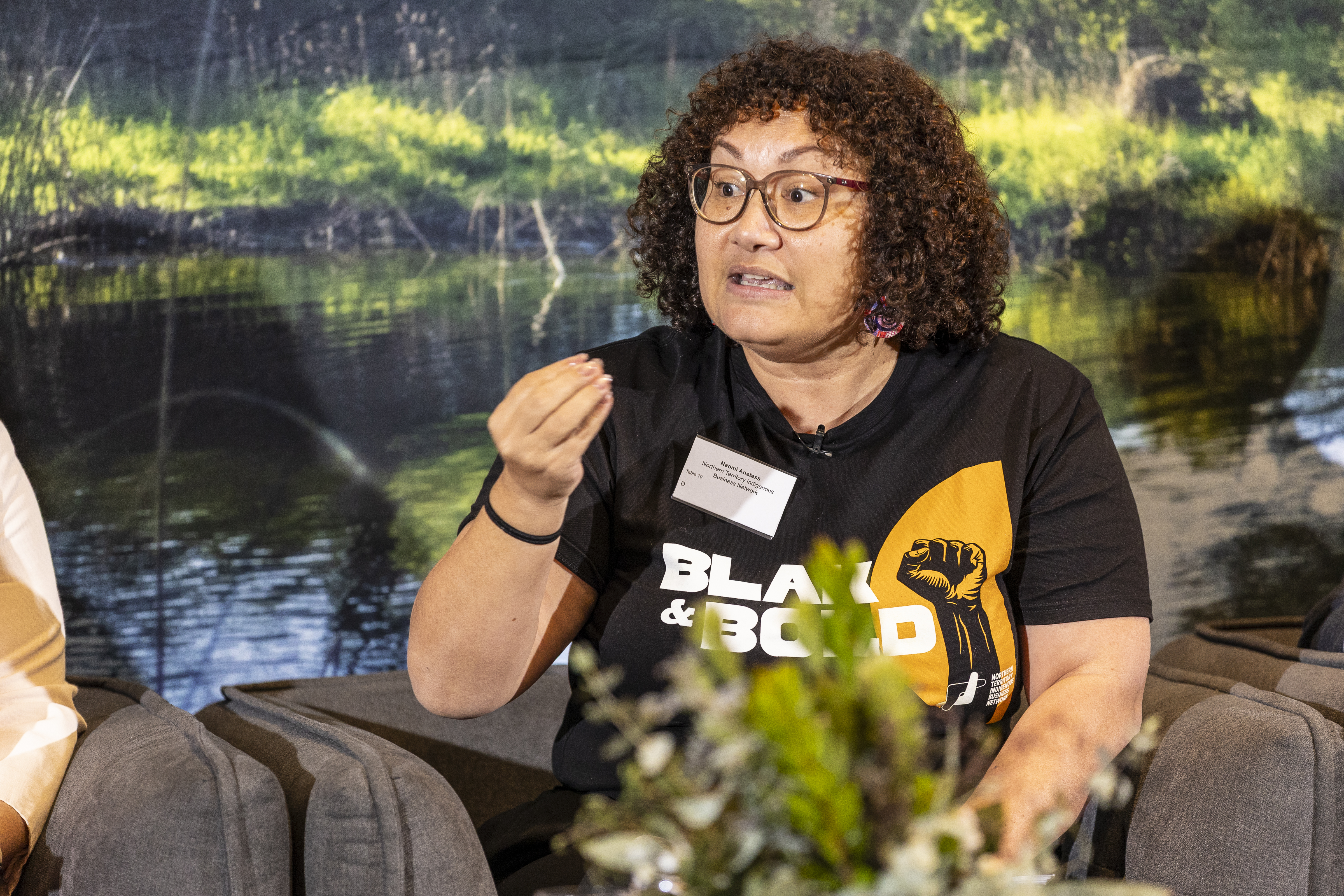
The tender comes amid concern about black cladding, where a business presents as Indigenous-controlled without genuine Indigenous ownership, control or benefit. Supply Nation currently occupies the dominant national position through Indigenous Business Direct. The National Indigenous Business Chambers Alliance, chaired by Northern Territory Indigenous Business Network chief executive Naomi Anstess, has been advocating for a stronger Indigenous-controlled, chamber-led approach to verification and procurement integrity.
IBR understands NIBCA has developed its own list of Indigenous businesses drawn from participating chamber memberships. It is not a direct equivalent to Supply Nation's national register, but it reflects a growing push for Indigenous chambers to play a more formal role in verification, local intelligence and community accountability.
Opening the summit, Professor Michelle Evans said Indigenous businesses must be understood as more than recipients of government purchasing decisions.
"They are not just simple beneficiaries of procurement policies," Professor Evans said. "Indigenous businesses are employers, innovators, knowledge holders, community anchors, and an important part that informs and strengthens Indigenous rights to economic self-determination."
She said their impact was measured not only in contracts or revenue but in "the jobs that are created, young people mentored, communities strengthened, and confidence built".
Shane Dexter, Branch Manager of Business and Economic Policy at the National Indigenous Australians Agency, said the IPP was not a failed policy requiring wholesale replacement.
"The IPP is a bit different in that there's a lot of success over the last 10 years," Mr Dexter said. "There's improvement that's needed, but we must make sure that we don't break what has driven that success."
Mr Dexter said the shift from 50 per cent Indigenous ownership to 51 per cent ownership and control was more than a technical adjustment.
"Fifty-one per cent is meaningful and introducing control to that definition is also meaningful," he said. "It's designed to ensure that Indigenous people are genuinely in control of their businesses and making decisions about where the benefits of those businesses flow."
But he warned that stronger assurance could impose extra burdens on the businesses the policy was designed to support.
"There is a tension between a thirst for more data and more research and more evidence," he said, warning that impact measurement could create "an administrative or red tape" burden.
"Why are you asking me to do that just because I'm an Indigenous business?" he said.
That concern was sharpened by research presented by Associate Professor Cain Polidano, a Principal Research Fellow at the Melbourne Institute of Applied Economic and Social Research.
The data showed the IPP had opened Commonwealth procurement to many firms for the first time. By 2022, 2,179 of 2,643 businesses analysed, or 82 per cent, had received their first Commonwealth contract under the IPP. The research also suggested the policy helped businesses learn how to navigate procurement systems, with growth in competitive Commonwealth contracts outside the IPP after 2015.
But the same data complicated the assumption that procurement spend automatically translates into direct Aboriginal and Torres Strait Islander employment.
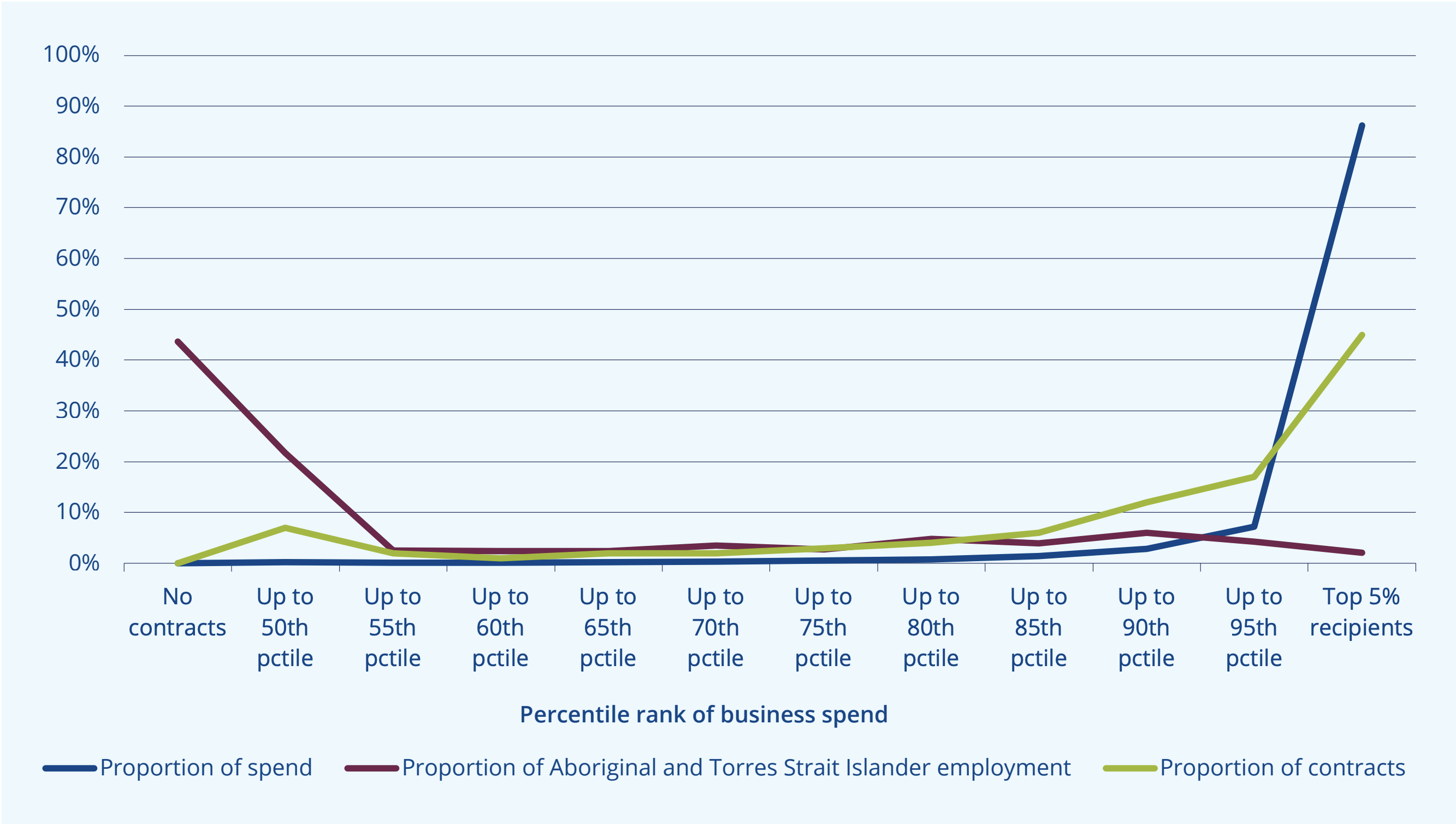
Businesses that won no IPP contracts still employed an estimated 44 per cent of all Aboriginal and Torres Strait Islander workers in the Indigenous business and corporation ecosystem. At the other end of the spectrum, the top 5 per cent of Indigenous firms, 107 businesses in total, won 86 per cent of total IPP spend and 45 per cent of IPP contracts, but employed only 2 per cent of the ecosystem's Indigenous workforce.
The finding does not mean the IPP has failed or that high-performing firms are not legitimate Indigenous businesses. Some operate in capital-intensive or specialist sectors where direct employment is not the only measure of impact.
But the data shows procurement spend, Indigenous ownership and Aboriginal employment outcomes do not always move together. If procurement policy is intended to support broader participation, the next phase will need more nuanced ways of measuring value.
For Supply Nation chief executive Kate Russell, the IPP should be understood as an important mechanism, but not a complete economic development framework.
"The IPP is a tool. It is a lever," Ms Russell told the summit. "Its intent, from what I understand, was to provide equity of opportunity and equity of access."
She said policymakers often assumed that once businesses entered procurement systems they would automatically grow, build capability and become more sustainable. But capability meant different things to different businesses.
"For some Indigenous businesses, some are mums and dads and they just want to put food on the table," she said. "Others want to put their kids through private school or go on big holidays. Some have aspirations to work internationally."
Ms Russell said the sector needed to be clearer about whether the IPP was being treated as social policy or economic policy.
"Is the IPP perfect? No. Does it need reform? Yes. But do we also need to talk about the broader economic and fiscal architecture of this country? Yes," she said.
In a recent interview, Ms Russell said Supply Nation audits "ownership, management and control", but procurers still needed to conduct their own due diligence.
"If we don't protect the credibility of Indigenous business, we undermine everyone," she said.
Supply Nation reported that Indigenous businesses verified through its systems recorded $5.83 billion in procurement spend in 2024-25, up more than $1 billion from the previous year.
Speaking to the Indigenous Business Review, Ms Anstess said the policy's success should now drive a more sophisticated approach to community impact.
"Blak business is good for the economy," she said.
"The Indigenous Procurement Policy remains one of the most successful economic policies ever delivered for Aboriginal enterprise, but it is now time to mature the system beyond contract counts and start measuring real community impact.
"We must stop tolerating black-cladding and token participation, and build sophisticated procurement models that recognise genuine Aboriginal ownership, employment, reinvestment and leadership."
Ms Anstess said NTIBN's research and engagement with Aboriginal businesses across the Territory showed that when Blak business grows, communities benefit through jobs, training, social participation and stronger local economies.
"Policy makers must listen directly to Indigenous business chambers and the businesses doing the work on the ground," she said.
"Aboriginal business is not a social program, it is an economic driver."
For major corporate buyers, the summit made clear that Indigenous procurement cannot sit at the edge of a business.
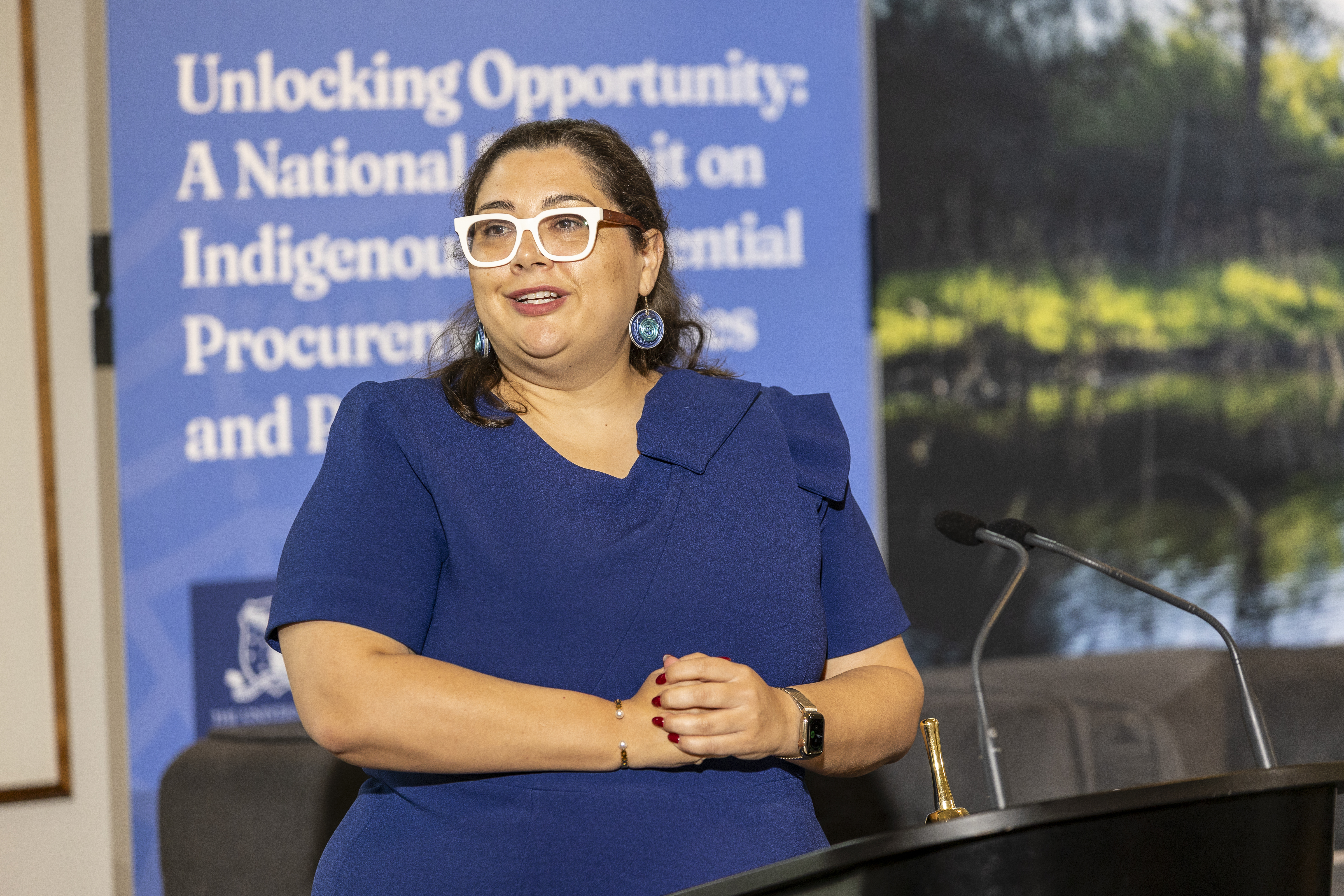
Jessica Simpson, BHP's Global Head of Governance and Social Value Procurement, said the Commercial function had placed its overall procurement systems, governance and social value together because social value was a key pillar of BHP's strategy.
"For me, intentional procurement, not transactional procurement," Ms Simpson said.
"It has to be the whole business. Having the entire workforce culturally competent and aligned helps enable your procurement policy tenfold."
Ms Simpson said large companies needed to provide clearer pipelines and longer contracts so Indigenous businesses could plan, invest and grow.
"Visibility and transparency will help businesses innovate," she said.
"I often hear from businesses, when planning is late, we can't ramp up. We can't invest in people or plant or capital."
Victorian MP Sheena Watt brought the discussion back to political power, visibility and government accountability. She recalled working in corporate Australia in 2002 and being told she was the only Aboriginal person in the building.
"Now I see rooms full of mob with thriving businesses," she said. "You cannot be what you cannot see."
Ms Watt said her vision was for "growing, thriving Aboriginal businesses" and for the Aboriginal economy to receive "the respect and dignity that it absolutely deserves".
The first decade of the IPP was largely about access. It opened government supply chains, helped Indigenous businesses enter new markets, and pushed governments and corporations to take Indigenous enterprise seriously.
The next decade will be about the quality of that access: who controls the business, who benefits from the contract, who verifies authenticity, who carries the reporting burden, and whether procurement spend is building broad-based Indigenous economic power or concentrating opportunity among a smaller group of firms.
Verification is not just paperwork. Measurement is not just data. Procurement is not just spend.
The harder task now is to build a system that protects integrity without smothering businesses in red tape, combines national scale with community accountability, and measures success not only by the value of contracts awarded, but by the strength, autonomy and future of the Indigenous business sector itself.