




Key points:
- In the mainstream economy, money cycles five to seven times. In the black economy, twice
- A Kimberley woman makes funeral flowers at cost so grieving families don't carry the burden
- "Who would give a Blackfella pastoral enterprise that kind of money with no experience?"
Aboriginal are people still struggling to leverage their own land to raise capital
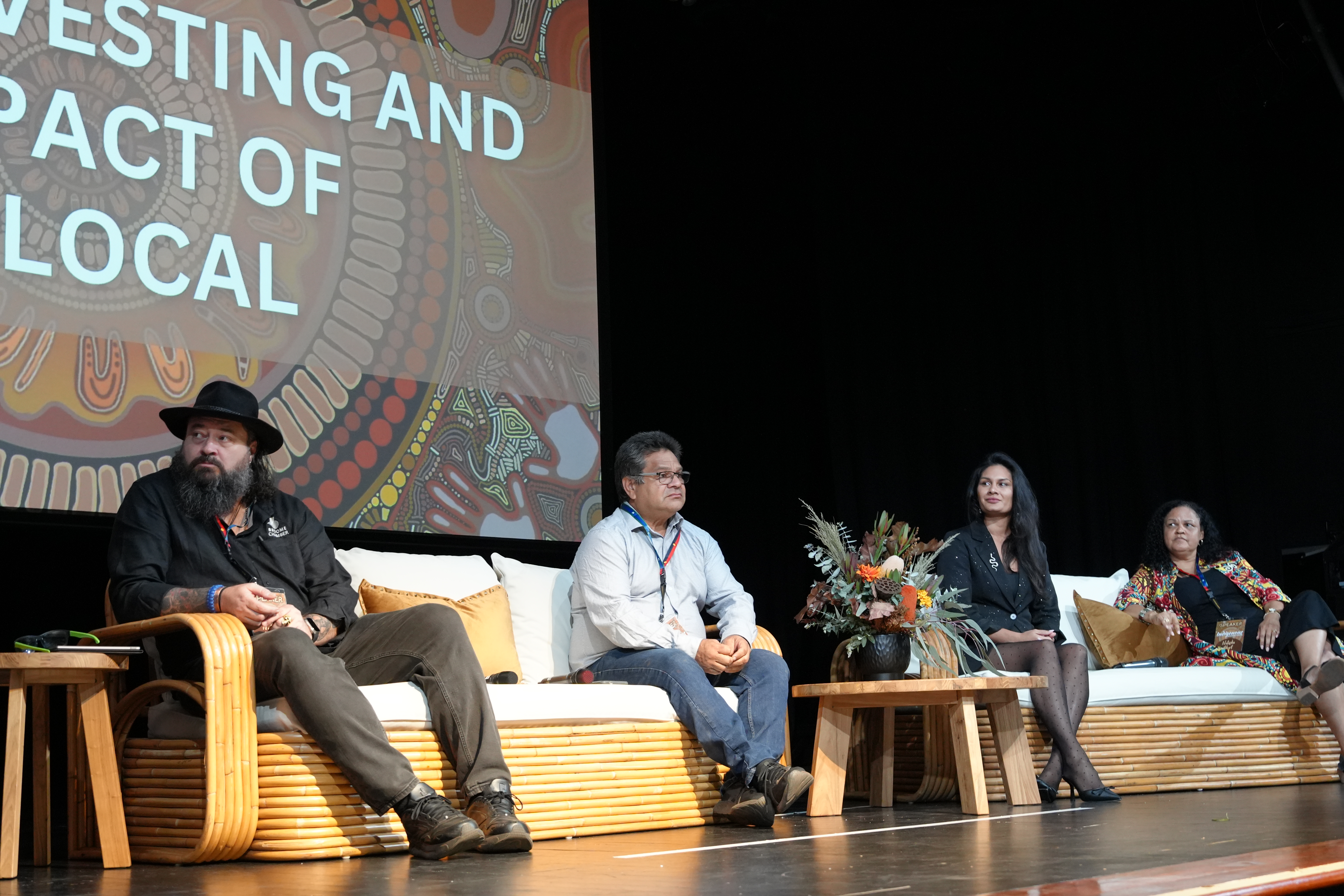
Caveats inside land transfers, divestments and lease arrangements prohibit onselling, which means Aboriginal people uniquely struggle to raise capital against their lands. Jordin Payne told the Impact Investing and Social Impact of Spending Local panel this is where the structural problem starts, and where the conversation about social impact has to start with it.
In the mainstream economy, money stays in circulation through five to seven cycles. In the black economy, you are lucky if it makes it twice.
"Money and opportunity literally move out of the black economy with almost every single contract," Payne said.
The funds that bankroll black enterprise come from the private market, and the Aboriginal slice of it is small. Payne said the government has a lot to answer for on how it funds the establishment of local black economies, rather than piecemealing money through contracts.
"Under the UN, we have indelible rights to build our own economic systems," Payne said. "We must gather the data and proof we need to show they are not delivering on the rights afforded to us as Aboriginal people."
Social impact, Payne said, is a long-term vision. A minimum of five years, building toward ten, twenty, fifty-year strategies. Annual reports won't move the dial. She pointed to a theory of change as the formal tool that lets a business position itself for impact investment, by identifying what matters, what value it can create, and where its capacity will land hardest.
Natasha Short, who runs Kimberley Jiyigas in Kununurra, told the panel every Indigenous business is already a social enterprise. They give back above and beyond what their balance sheets show.
"I was talking to someone yesterday, she's making flowers for funerals," Short said. "She's not making any money out of this. She said, 'I want to contribute to that family in their time of need.' Our people are going above and beyond."
Non-Indigenous operators, Short said, position themselves inside Aboriginal communities, extract from them, and become multi-millionaires, while their give-back is nowhere near what mob does for mob.
The sector also has to start valuing its own intellectual property. Short described a school that put a young Aboriginal artist's work on its uniforms and never paid him, because he was a kid.
"That's his IP. We need to instill the worth and value of our IP and operations in everyday life, particularly with our young people," Short said.
What that looks like at scale is KAPCO. Wayne Bergmann tried to assemble ten Aboriginal pastoral stations nine years ago. He ended up with four. He needed $11.5 million.
"Who would give a Blackfella pastoral enterprise that kind of money with no experience?" Bergmann said.
Marra Worra Worra backed it with $5 million in subordinated debt, ranking behind the Commonwealth Bank, which gave the bank the confidence to come in. The banks would not lend money on the land at all, so KAPCO mortgaged the cattle. Standard farming lending sits at 50 per cent of land and stock value combined. KAPCO was kicked off on 40 per cent of stock value.
The shires then hit KAPCO with rates of around $180,000 to $230,000 on exclusive possession native title lands before a single cow had been sold.
"It's our traditional land. Exclusive possession native title. We're paying rates on it. Does it make sense?" Bergmann said.
Bergmann is sceptical of the framework that was supposed to make all this work. Native title agreements, he said, are not worth the paper they are printed on. What makes the difference is individual managers inside the companies who walk side-by-side with traditional owners and tick the box. They are not the people with the key to the safe, but they are the people who can sign off on giving mob a go.
Leedal, the 100 per cent Aboriginal-owned company Bergmann chairs, owned by six Fitzroy Crossing community organisations, bankrolled KAPCO first kill last year. Fresh Shorthorn went on the shelves in Fitzroy and around 10 tonnes sold in eight days. People said you couldn't slaughter cattle from the Kimberley and sell it on the shelves.
Indigenous employment at the pastoral station now sits at about 70 per cent, and workers are shifting from casual seasonal payments to year-round salaries.
"With that, they can go to a bank, get a loan, buy a car, you can start making changes," Bergmann said.
Nathan McIvor, from Djarindjin on the Dampier Peninsula, said welfare has been around for a long time. Intergenerational wealth has not.
Since Djarindjin took over full ownership and operation of Djarindjin Airport on 1 February 2022, three or four generations of local people have been working at the facility, training each other up. Djarindjin and Lombadina are now working with the state government to build what McIvor said will be the only 100 per cent Aboriginal-owned renewable energy farm in Western Australia.
"The social benefits are huge. But the government doesn't see it that way, because they see it from a monetary point of view," McIvor said.
"Data is king, data is sovereign, and it should belong to those communities and Indigenous businesses," McIvor said. None of Djarindjin's own data, taken over 40 to 60 years, sits inside Djarindjin.
McIvor said Djarindjin represents communities that have the capacity to move into business and out of poverty, and the organisation wants to share that knowledge. But the systems themselves try to stop that knowledge being shared.
"It is about taking care of each other and treating each other like human beings," McIvor said. "Not being sucked into a system that thinks Aboriginal people are just a commodity. Aboriginal people are not a commodity. They have been around for 65,000 years and they were doing a bloody good job before."
"To make a change, you don't go to the government and say, 'Give us money to make that change,'" McIvor said. "You've got to put your hand in your own pocket. You've got to start thinking bigger. You've got to start thinking about building that intergenerational wealth for the communities."
Leedal is spending $10 million on new tourism facilities in Fitzroy.
"Social impact is about making that human change," Bergmann said. "And where you can spend your money locally, that has that positive impact."
Note: Wayne Bergmann is a co-owner of the National Indigenous Times.