



Key Points
- Australia's big banks refused to lend to an Aboriginal pastoral company on standard terms, and it had nothing to do with the books.
- A Supply Nation-registered business with an Aboriginal major shareholder still ended up as black cladding.
- The Kimberley economy is worth $8 billion. Adele Peek is asking how much of it reaches Aboriginal hands.
Kimberley voices are speaking out on the future of Indigenous business
When KRED Enterprises set out to capitalise the Kimberley Agriculture and Pastoral Company (KAPCO), its leadership expected the hard part to be knitting communities, landholders and a Prescribed Body Corporate together, then operating the joint venture profitably. What surprised them came from corporate Australia.
"Some of the big financial institutions did not want to lend money on the same terms as what they did to non-Indigenous pastoralists," KRED Enterprises CEO Damien Parriman told the panel. "The reason for that was that they did not want to be seen to be foreclosing on Aboriginal-held land if things didn't go the way we planned."
The workaround required raising capital without securing it against land, which is standard practice in the industry. "Even when you do think you've got the land tenure stuff sorted, you bump into something else," Parriman said.
Parriman returned later to a related point about Indigenous procurement, arguing that corporate commitments need to move past media statements into binding agreements that spell out, in operational detail, how local and Aboriginal businesses will actually be supported when tenders are assessed on price.
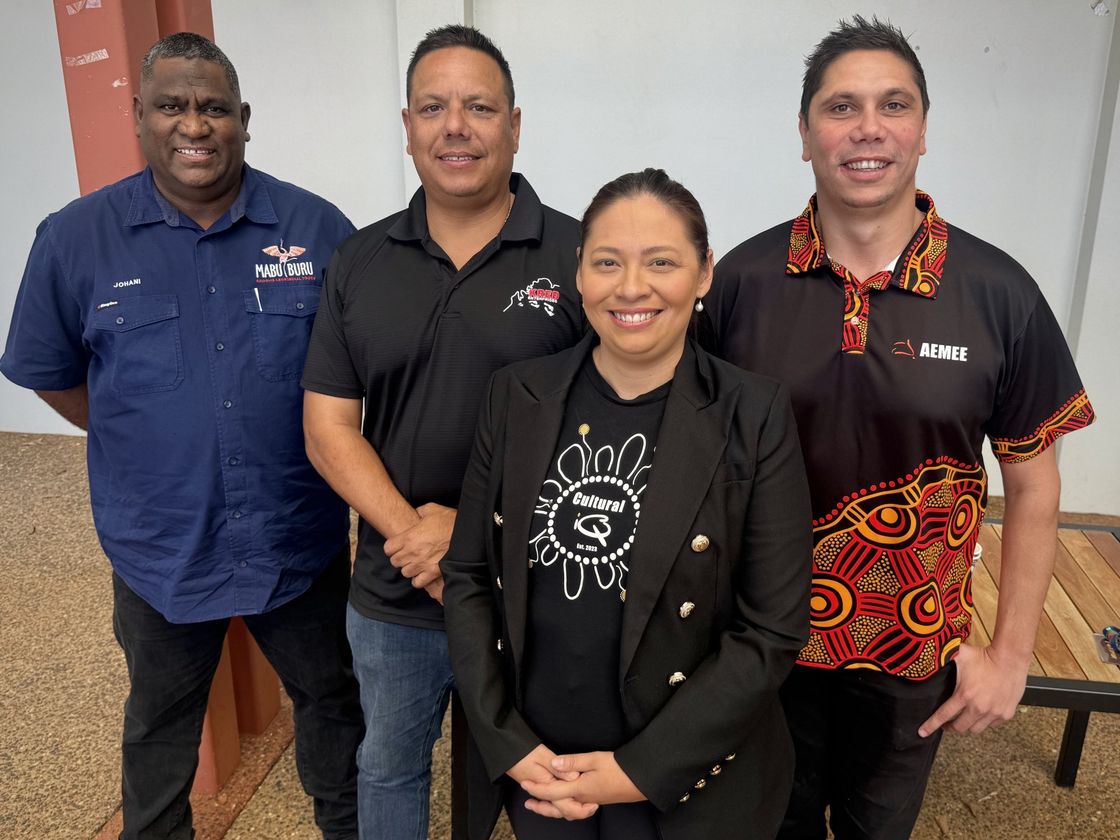
Parriman's account opened Panel One at this year's Kimberley Indigenous business forum, chaired by Indigenous Business Australia's Darren Godwell. Four panellists, a peak-body chief executive, a tourism operator, a pastoral enterprise leader, and an entrepreneurship educator, used their time to map the structural barriers that still stand between Kimberley operators and the industries they are trying to enter.
A peak body's view from the resource sector
Jyi Lawton, CEO of Aboriginal Enterprises in Mining, Energy and Exploration (AEMEE), put the resource-sector question in scale terms. AEMEE's vision, he said, is to grow Indigenous market share in resources, "not as suppliers and not as contractors too, but as ownership of projects and running the projects."
He pointed forward to the next redevelopment of Cable Beach as the kind of horizon worth aiming at, a project that should, by then, be Indigenous-led. Indigenous voices are needed at the extraction table more than ever, he said. "We all have laptops, phones and cars and we all need electricity... and therefore we need resources. But also we need our connection to the country and we need to make sure it's done properly."
"When we're owning that table and building that table and creating that table and sitting at that table, that's where we're being able to do that."
On failure: "If our old people stopped at that first block, we wouldn't be on this stage."
A tourism operator on the world that won't slow down
Johani Mamid, a Yawuru, Karajarri, Nyul Nyul and Bardi man who runs Mabu Buru Tours on Cable Beach, brought the historical frame. Aboriginal people had everything they needed before colonisation, he said. The post-1970s era is best understood as a recovery period, but a peculiar one. "We're playing catch-up to a world that's been going straight past us constantly. It's not stagnant."
That shaped his answer on emerging industries: everything. Mining, ports, aviation, online commerce. "If anybody wants to do mining, then guess what, they have to get in a partnership with us, because we own that lease."
Mamid also spoke candidly about a personal lesson. He described a venture with non-Kimberley partners in which, despite his role as a major shareholder and the business's Supply Nation registration, he eventually realised he had been part of a black-cladding arrangement. "If you're not really careful in the business space you can end up in tricky situations like that whether you know it or not." His account raises a live question about what current certification frameworks actually protect against, when a registered, shareholder-aware Aboriginal businessman can still be caught.
He closed with a call for reconciliation within communities, not just between them. "Native Title is like a business or a company that we actually manage as members, and as long as we work together we can make that, which is a very young system, complicated much easier."
An entrepreneurship educator on the politics of the room
Adele Peek, a Yawuru/Bunuba woman and co-founder of Make It Happen HQ with her sister Cara Peek, used her time to turn the conversation toward the audience. "I'm not prepared to play by white man's rules. I'm prepared to create my own, and in doing so, that means you become an ally to someone, an enemy to many."
The Kimberley economy, she noted, is worth roughly $8 billion. "Can you really say you've opened the door for the person sitting next to you on the next table? Can you really say you've made an introduction?" The deepest failure, she argued, is the pursuit of ego. "If that's actually set aside, we can do some really amazing things in business together."
Peek and her sister built Make It Happen HQ, an innovation hub for First Nations entrepreneurs, after their own early experience with Indigenous business agencies. "We got told, 'You're too smart for us. Here's the money. You go figure it out.' Wasn't enough money, but we figured it out."
"In 20 years' time, while I'm waving at you from the billionaire hill, I'll still be putting my hand out, not to give you a handout, but to give you a hand up." She tied that ambition to the Kimberley's youth suicide rate. "Our young people who get caught up in silly decisions are just entrepreneurs who haven't had a crack yet."
Peek closed with a direct ask to the funders and corporates in the room. "Cash is king. Open your wallets. Guess what, it's not your money. It's the company's." Hire Kimberley consultants rather than flying in the big four from Perth, she argued. Fund the pipeline. "I hope that people actually back black solutions."
Four panellists, four industries, four arguments that share the same edge: the twenty-year horizon depends on decisions being made now, by the people who were in the room. "It's about we, not I."