





Key Points:
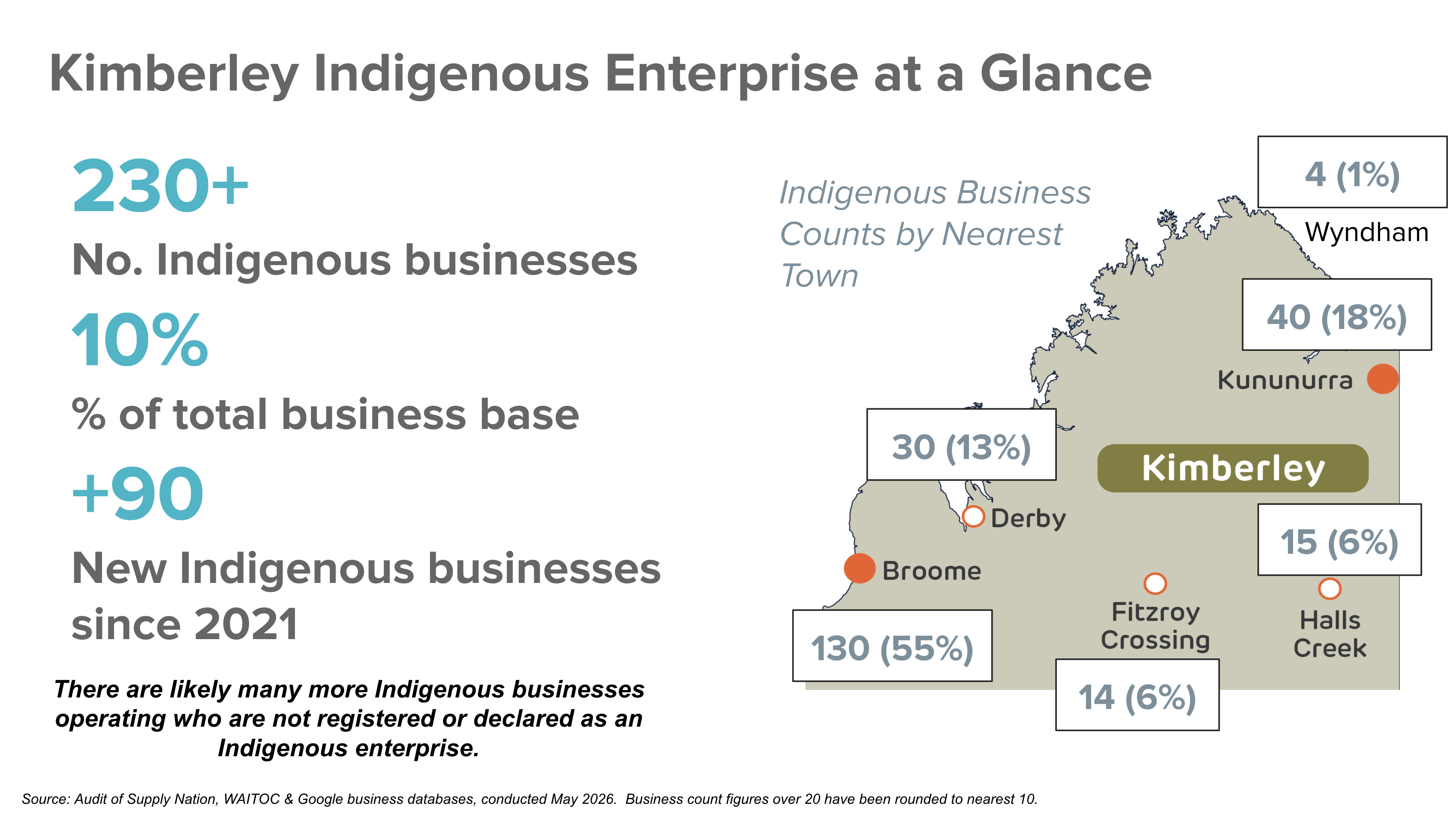
- The Kimberley's Indigenous business sector has hit 230 enterprises and ten per cent of the regional economy, with 90 new operators in four years.
- A $5.4 billion mining pipeline is heading for the region, yet Indigenous businesses hold one per cent of the sector.
- Nathan McIvor's verdict on the regulator he says is holding the sector back: "Get rid of ORIC for starters."
Indigenous-owned enterprises now make up ten per cent of the Kimberley's business base. With $5.4 billion in mining investment heading for the region and Indigenous businesses holding one per cent of the sector, today's economic snapshot at the Broome Chamber asked whether momentum is enough.
More than 230 Indigenous businesses now operate across the Kimberley. They make up ten per cent of the region's total business base, and more than 90 have been established since 2021. In mining, the sector about to receive $5.4 billion in new investment over the next decade, they hold one per cent.
This imbalance was the heart of an address delivered on Tuesday by Djarindjin Aboriginal Corporation chief executive Nathan McIvor at the Broome Chamber of Commerce and Industry's Indigenous Business Forum. Presenting research compiled by Julia Cretan Economics and Research for the Kimberley Development Commission, McIvor laid out a picture that was both a credit to the sector and a warning about what could come next.
Where the sector sits
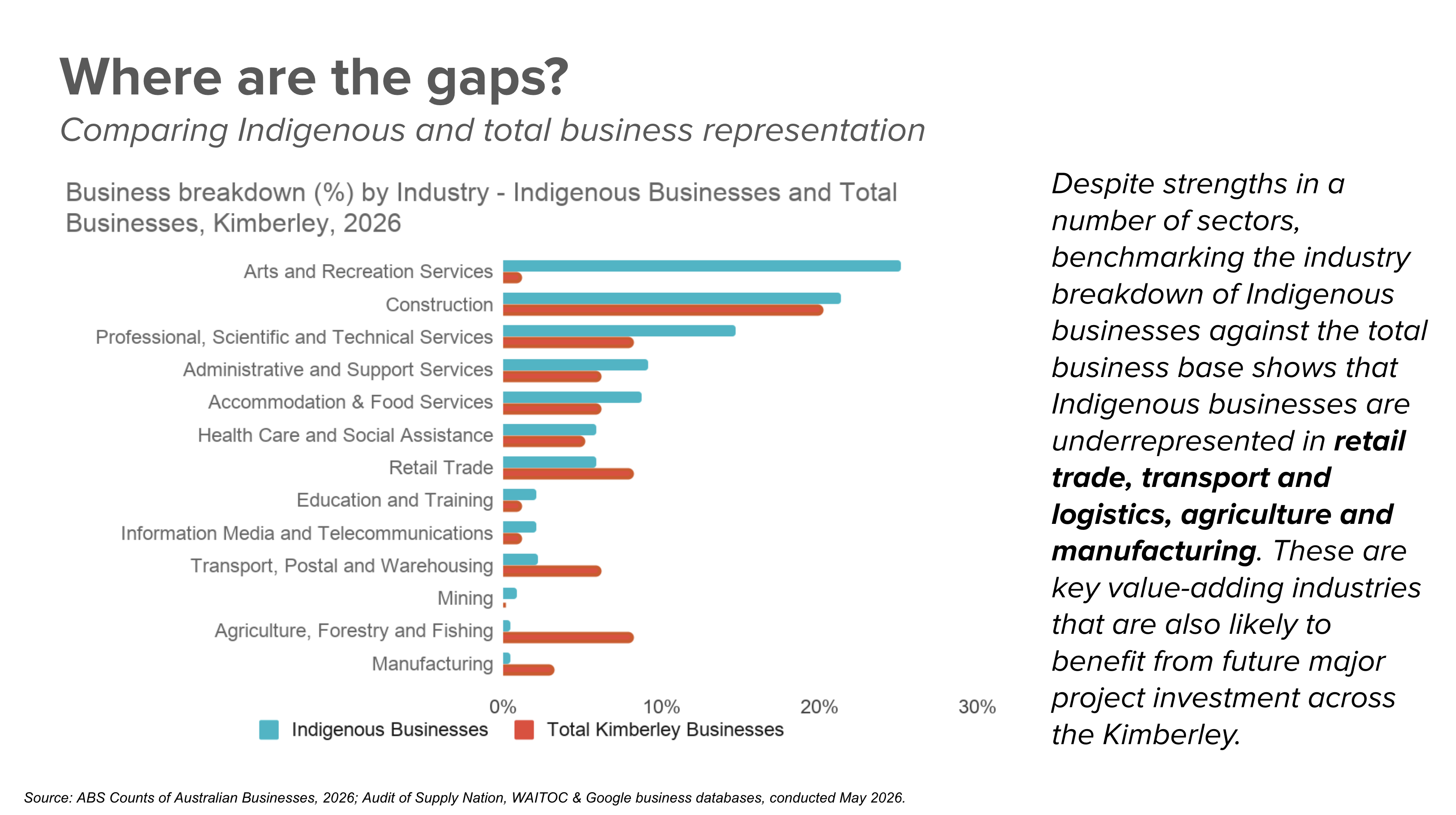
Broome accounts for 130 of the region's Indigenous businesses, with the balance spread across Kununurra, Derby, Halls Creek, Fitzroy Crossing and Wyndham. Three industries dominate the sector: arts and recreation services at 25 per cent, construction at 21 per cent, and professional services at 15 per cent. Cultural tourism, art centres and on-Country experiences drive the first. Civil works and maintenance contracts drive the second. Native title bodies, land management, ranger groups and environmental consulting drive the third. Together those industries account for more than half of all Indigenous enterprises in the region.
McIvor was confident the real numbers are higher. "There are likely many more Indigenous businesses operating who are not registered or declared as an Indigenous enterprise," he told the Forum. "If you know of anybody out there that's not declared themselves as an Indigenous enterprise or a business, tell them to register."
The composition of the sector is the article's central tension. Indigenous businesses are clustered in cultural and community-facing industries and underrepresented across retail trade, transport and logistics, agriculture, manufacturing and mining. Those are the same industries about to absorb the largest share of the Kimberley's coming investment.
The pipeline
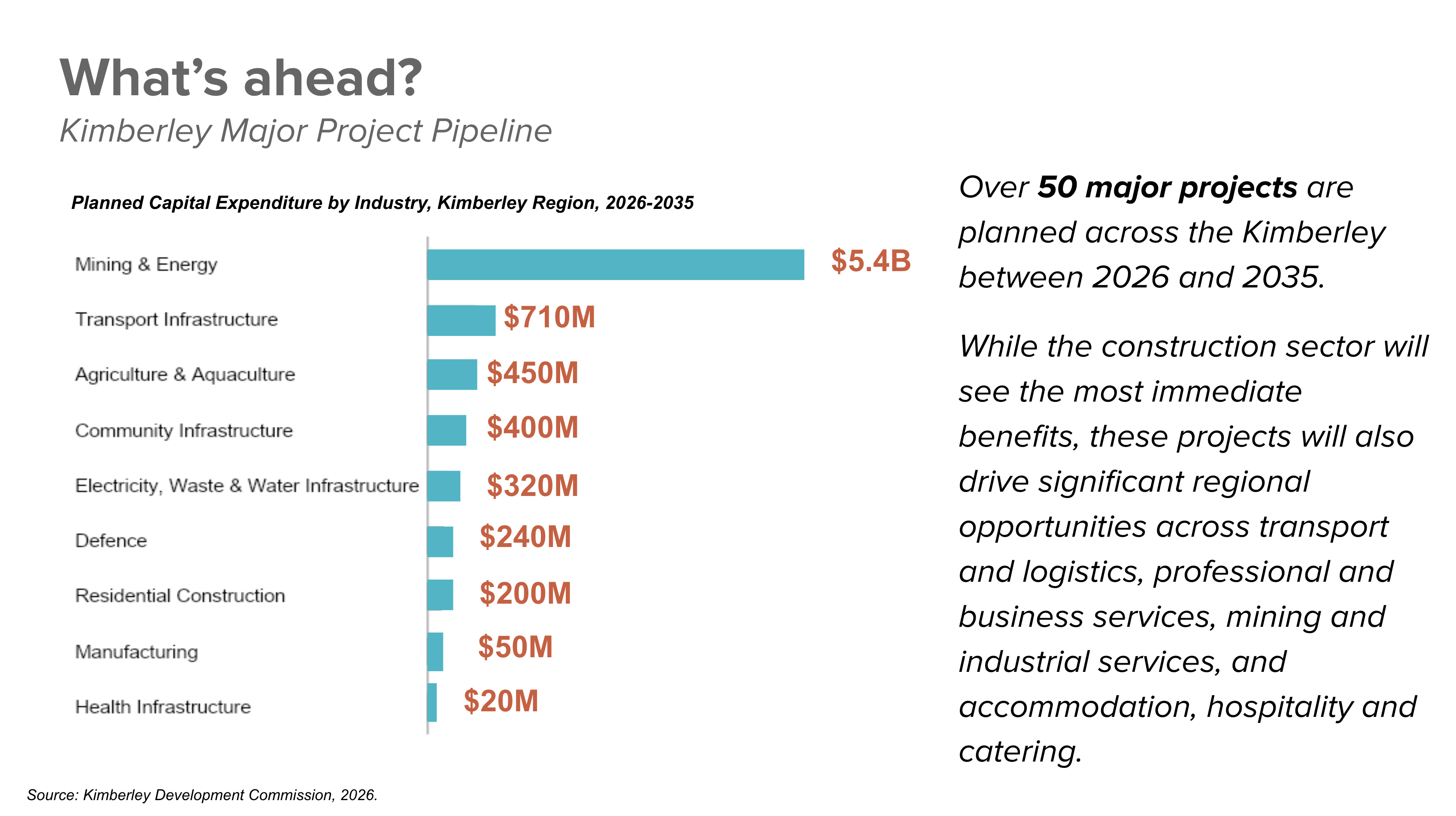
Between 2026 and 2035, more than 50 major projects are planned across the Kimberley. Mining and energy account for $5.4 billion of the spend. Transport infrastructure adds $710 million, agriculture and aquaculture $450 million, community infrastructure $400 million, with further investment flowing through electricity and water, defence, residential construction, manufacturing and health.
Construction will see the most immediate benefit. The flow-on opportunities are arguably where Indigenous businesses are best positioned to compete: transport and logistics, professional and business services, mining and industrial services, and accommodation, hospitality and catering. "There's a huge opportunity for Aboriginal businesses in the Kimberley," McIvor told the room, "to get some of the $5.4 billion that is going into the mining sector."
The barriers
The Cretan research identifies eight structural barriers. A trust deficit limiting access to finance and supplier networks. Tender processes that favour large external firms with the scale and time to compete. Workforce gaps. Black cladding by non-Indigenous firms exploiting Indigenous credentials to win contracts. Scale and contract concentration that leave small operators exposed to market shocks. And the two McIvor returned to as the most structural of the eight: capital and regulation.
On capital: "A lot of non-Indigenous businesses have collateral through land," McIvor told the Forum. "Many Indigenous businesses don't have land because it's still owned by the state or somebody else. That makes it very difficult for businesses to grow." A financing system built on collateral does not serve a sector excluded from collateral ownership.
On regulation, he reserved his sharpest words for the Office of the Registrar of Indigenous Corporations, describing it as one of the most stringent regulators Aboriginal organisations encounter and arguing the compliance burden exceeds what ASIC imposes on non-Indigenous counterparts. "There needs to be something that happens in that space," he said. "Like get rid of ORIC for starters, and have a system in place that is much easier for Indigenous businesses and corporations to be able to operate in."
On workforce, McIvor was more nuanced. Labour shortages constrain growth, but layered beneath them, he said, are "60 years of welfare mentality" that have made the transition into enterprise participation structurally difficult. Indigenous businesses, he argued, are the most effective vehicle for activating that latent workforce.
What's working
On joint ventures, McIvor was emphatic that ambition matters as much as access. "Don't be looking at five per cent equity," he told the room. "Look at more than fifty per cent. Aim high, go for one hundred. Then you can bargain from there. If you go into the room and you're only getting five per cent equity, then it's not worth what's on the paper."
Concrete examples already exist in the region. The Broome Chamber is developing a trade cooperative to help Kimberley trades tender for the larger jobs that currently flow to east coast and southern firms. Djarindjin is purchasing a freight company to service the Dampier Peninsula and, McIvor said, end the price-gouging currently practised in the regional freight market. Djarindjin Aboriginal Corporation, where McIvor is chief executive, has built a community-owned solar and battery project, Aalga Goolil.
These arrangements are working because the policy environment is finally beginning to enable them. Preferential procurement policies and the practice of breaking large tenders into smaller, accessible packages are widening the field. Longer four-to-five-year contracts give Indigenous businesses runway to invest in workforce development and apprenticeships rather than scrambling between short cycles. Targeted finance through Indigenous Business Australia, grants and loan schemes are chipping away at the capital constraint. Joint ventures with established firms are unlocking larger contracts and transferring capability.
The ask of partners
The researchsets out a clear ask of government, industry and project proponents engaging with Indigenous businesses. Five verbs:
Enable access by breaking large contracts into accessible packages, engaging early, and running in-region supplier briefings.
Enforce expectations by embedding Indigenous procurement targets into contracts and mandating subcontracting opportunities.
Build long-term relationships through multi-year agreements and preferred supplier panels.
Remove structural barriers via faster payments, mobilisation support, and right-sized insurance and compliance requirements.
Measure outcomes, including businesses engaged, jobs created and long-term supplier growth, with improved data and visibility of the sector.
McIvor was direct about why this matters. The economic momentum is real, but the architecture around it has not caught up. "We've got to enable the access and participation," he told the room. "Set clear and enforceable expectations. Build long-term, not transactional relationships. Remove structural barriers to growth and track, measure and strengthen outcomes." The work, in other words, is not the framework. The work is making it stick.
The stakes
The Kimberley has built a strong Indigenous business sector. Ninety new Indigenous businesses in four years is impressive, and the region is now positioned for something bigger. With 230 enterprises, a documented $5.4 billion mining pipeline, established support institutions and operators already demonstrating what community-owned infrastructure looks like, the next decade has every condition required for Indigenous businesses to claim a leading share of the projects shaping the regional economy. The question is no longer whether the sector can grow. It is how high it is prepared to aim.