



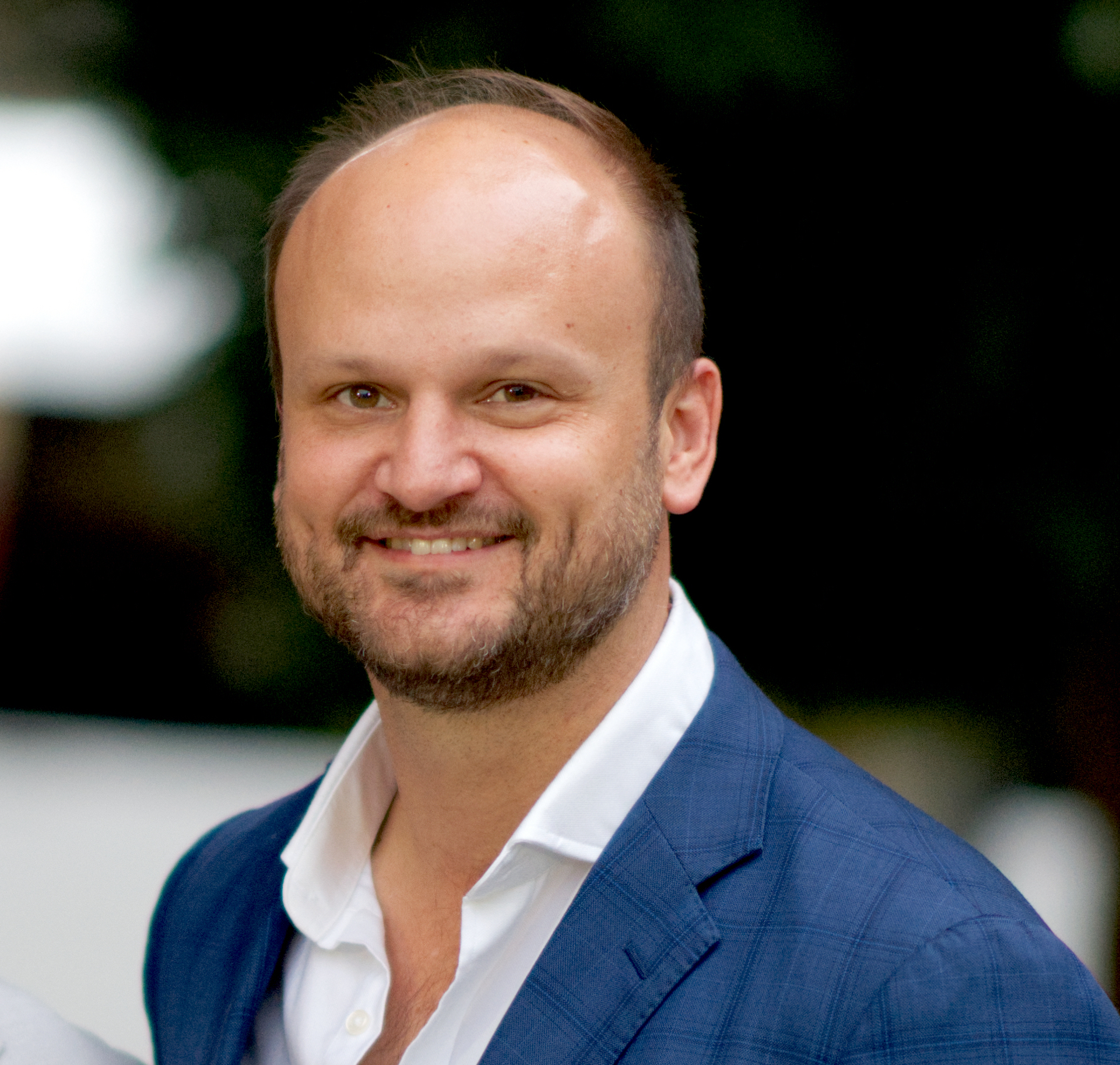

Zak Kirkup grew up in Midland, in Boorloo/Perth's eastern suburbs, in a family shaped by the long shadow of Yamatji history.
His father's family are from the Champion Bay region near Geraldton, descended from the small Wilunyu group whose lives were defined for decades by restrictions imposed on Aboriginal people. That legacy, combined with the realities of his childhood, shaped how he understands identity and responsibility.
His grandfather was born on an Aboriginal reservation outside Geraldton, where strict controls governed daily life.
"They grew up on the reservation, unable to come into Geraldton without police consent, unable to marry freely or run a business," he says.
A historical account of his family's matriarch, Granny Kirkup, records that "around 90 per cent of us were wiped out as a group".
He saw early how this history shaped present-day circumstances.
"According to the book we were quite established around the Champion Bay area, and then obviously devastated when the British arrived."
The contrast between the past and his own opportunities pushed him towards public life.
"Politics or public service was the way out for me," he says. "That was the thing that let me march out of Midland and get out of the cycle of struggle."
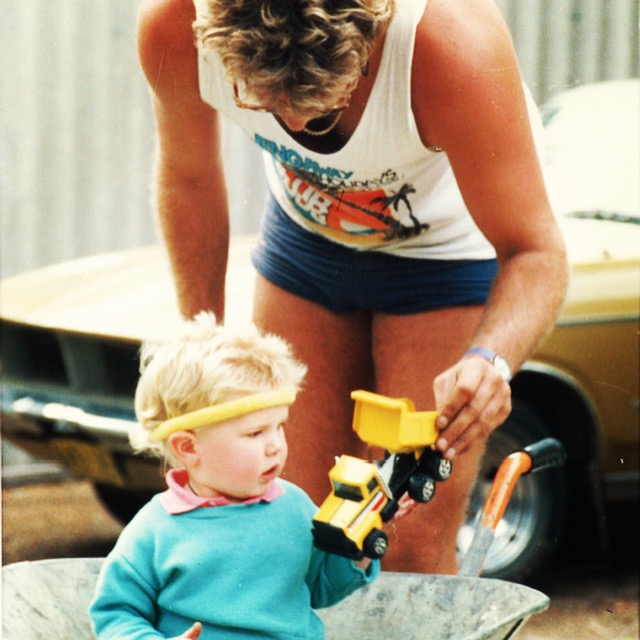
Rising fast, falling hard
Kirkup entered Parliament young and became Leader of the Opposition ahead of the 2021 state election. It was a contest defined by overwhelming public support for Premier Mark McGowan's COVID leadership. The Liberal Party suffered a historic defeat, and Kirkup's political career ended abruptly.
"It was a massive amount of depression and being very unsure about what to do with my life," he says. He had left university early and spent "the vast majority" of his adult life in politics. "I had nothing to fall back on."
A conversation with future business partner Adam Di Placido helped set a new direction. Di Placido had read his speeches about his father, grandfather and the structural racism that shaped their lives.
"Adam said, why don't you do something in that," Kirkup recalls.
The suggestion prompted him to see enterprise as a tool for social change.
"I believe the most important thing you can do is give someone a job or training so they can make their lives better," he says. That idea became the foundation of the companies he would build.
Kolbang and PowerOn: Creating pathways through trades
Kolbang launched in 2021 as an electrical services company built around Aboriginal employment and apprenticeships.
"We focus on electrical services, and we work with apprentices through to electricians," Kirkup notes.
Employees have joined from across Western Australia and interstate. "We've got people who've moved from Broome and Kununurra, even Tasmania," he says. "There's pride in helping someone get a trade, especially if they can go back and help look after their own community."
Kolbang grew rapidly.
"We're the largest private employer of Aboriginal people in the electrical services space in WA," he says, reflecting its design as a dedicated Indigenous employer.
Expanding into civil construction
In 2023, Kirkup acquired PowerOn Cabling, a horizontal drilling and civil works company.
"It picks up everything that's above ground and puts it underground," he says. Drilling offered an alternative pathway for workers. "Unlike electrical, it's not years of certification. It's small groups and outside. It's a great opportunity."
PowerOn has since expanded into constructing electrical substations for major infrastructure projects, including Metronet and the state's clean energy link. Aboriginal employment has risen steadily.
"We've used what we learnt at Kolbang and grown PowerOn from nearly no Aboriginal employment to now 16 per cent," he says. "That is continuing to grow nearly every month."
Indigenous ownership in a global system
In 2025, Kirkup acquired a majority stake in Chalkwest, the long-standing Western Australian franchise for Budget Car and Truck Rental.
"Chalkwest is a franchise holder of the Budget brand," he says. The business operates in 12 locations, including seven regional airports, and manages a fleet of more than 1,300 vehicles.
Some of the state's largest employers rely on Chalkwest. "Some of the largest companies in the country have relied on Chalkwest for 25 years to keep them moving," he says. "BHP, Rio, MinRes, the Government of Western Australia."
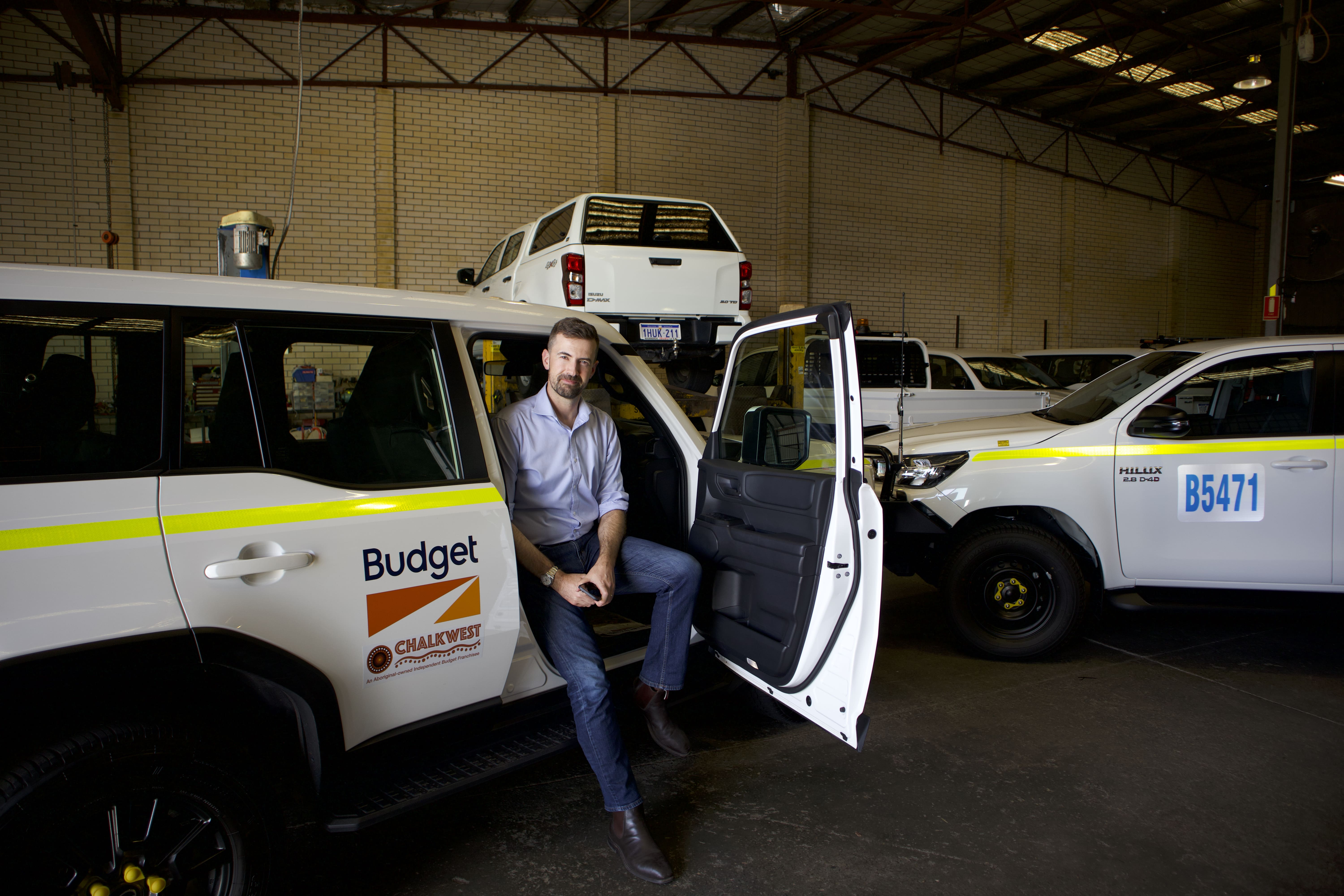
Chalkwest expands Indigenous employment into regions where Kolbang and PowerOn do not operate. Mechanics, detailers and customer service roles create opportunities in the Pilbara, South West and metropolitan Perth.
He sees mechanical apprenticeships as a natural extension. "Cars are so important for connecting Aboriginal people to community, particularly in regional and remote WA," he says. "I really want to get into the mechanical space. I think that'll be my next move."
The company's identity is central to its value. "We are part of a global business, but we're owned locally," he says. "We're the only Aboriginal-owned global franchise in the country."
A familiar vehicle, he adds, comes with a different kind of impact. "A Hilux is a Hilux, but the difference with Chalkwest is a client can probably get it better from us, probably cheaper, and they'll know they're helping support the Aboriginal community with training, employment and broader support for mob-owned causes."
Life beyond Parliament
Running three companies while raising a young child with his wife Katie leaves little time for hobbies.
"All I do is read, run, come to work or look after ten-month-old Theodore with Katie," he says.
Running remains central to his balance and wellbeing. "Running has kept me alive," he says. Parliamentary life, by contrast, was "a daily battle."
Enterprise as impact
Kirkup believes business now gives him a more direct path to community impact than Parliament ever did.
"We're giving more jobs, opportunity and having a greater impact than when I was elected," he says. "That is the benefit of enterprise."
People often assume, as a former Liberal leader, that he grew up in privilege. "Instead my family's struggled," he says. "Generations of racial injustice and structural inequality."
Across Kolbang, PowerOn and Chalkwest, he follows a consistent model: build strong commercial enterprises, prioritise Aboriginal employment and invest deeply in training.
"It is about helping support people in their journey of employment and training to help close the gap."
For Kirkup, the work is practical, grounded and forward-looking. It is also shaped by the place he began: Midland, the Champion Bay region and the resilience of a family that survived despite the odds. He now wants the next generation to walk into a very different future.