




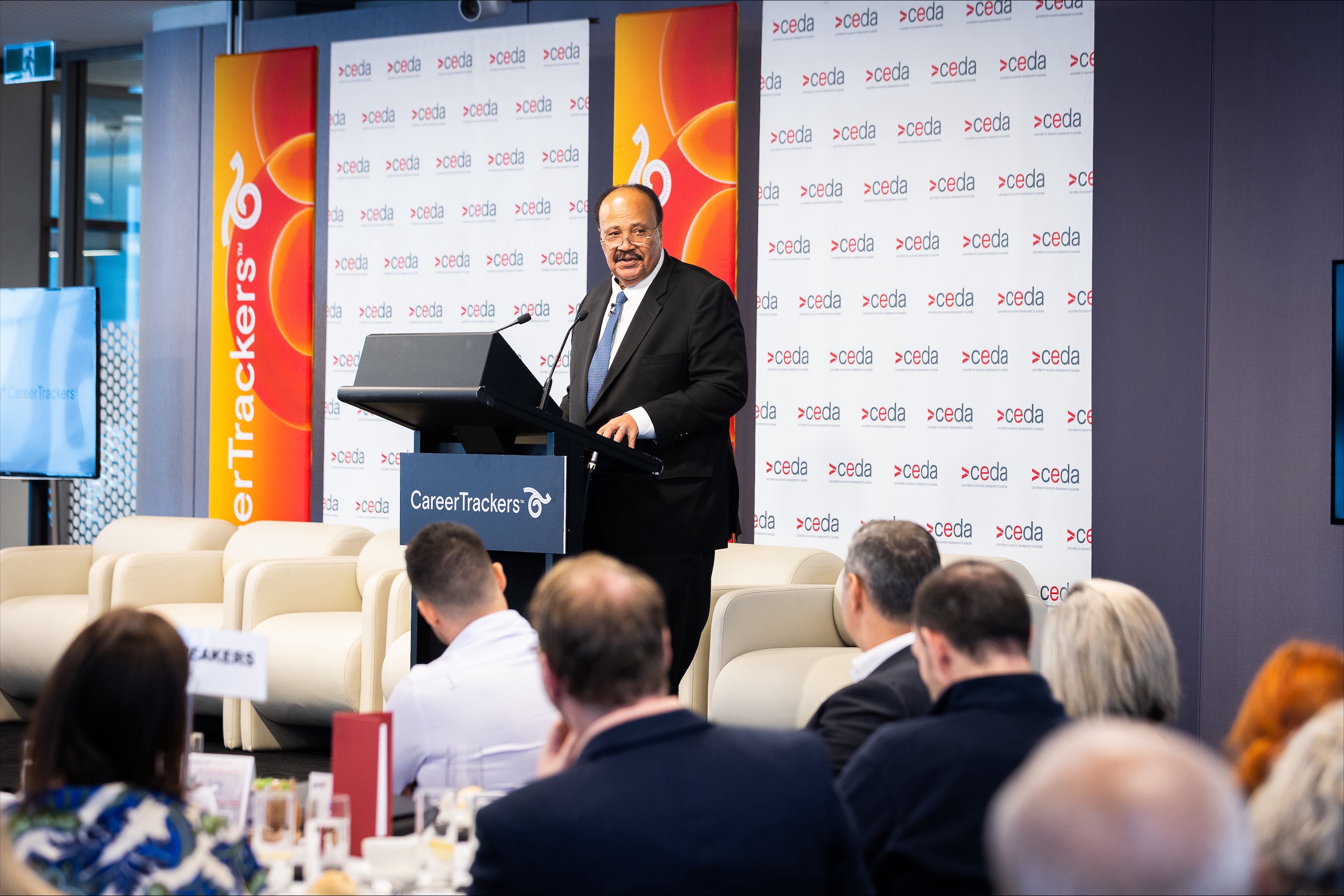
In a direct challenge to the nation's business elite, global human rights leader Martin Luther King III has declared that the stalling of Indigenous economic advancement is not a failure of talent, but a failure of gatekeepers to dismantle "structural barriers".
Speaking at a forum hosted by the Committee for Economic Development of Australia (CEDA) and CareerTrackers today, Mr King argued that the corporate sector holds the keys to the next phase of the civil rights struggle: economic justice.
"You decide who gets experience, who gets mentorships, who gets visibility, who gets promoted, who gets trusted," Mr King told the room of executives. "You're not just employers. You are architects of the next generation of leadership".
The Myth of the Meritocracy
Mr King addressed the persistent lack of Indigenous representation in senior Australian leadership, where First Nations people hold just 0.4 per cent of executive roles. He firmly rejected the notion that this disparity stems from a lack of capability within the Indigenous community.
"This gap is not a reflection of ability. It's not a lack of aspiration. It's not a shortage of talent. It is the result of structure barriers," Mr King said.
He identified these barriers as existing in "education pathways, in recruitment practices, in access to networks, and in assumptions about who belongs in positions of influence".
Drawing on the legacy of his father, Dr Martin Luther King Jr., he reminded the audience that "true compassion is more than flinging a coin to a beggar."
"It comes to see that an edifice which produces beggars really does need restructuring," he said. "This is a hard statement. But I believe it's a necessary one because symbolic commitments are not enough... What matters is whether we redesign systems so that opportunity flows to those who have been denied it for far too long".
Mr King urged Australian businesses to move beyond viewing Indigenous employment through the lens of Corporate Social Responsibility (CSR) or benevolence.
"Justice is not a zero sum game. Inclusion is not charity. Diversity is not a burden. Diversity is a competitive advantage," he said.
"Inclusive companies outperform because they draw on a wider range of ideas, experiences, and perspectives. Inclusive economies grow because they do not waste talent."
He argued that when a nation "systematically overlooks the talent of its first peoples, that nation is operating far below its true capacity".
The Economics of Change
Reflecting on the American civil rights movement, Mr King noted that moral suasion was rarely enough to drive systemic change without economic pressure. He cited the 1955 Montgomery bus boycott as a prime example of economic reality driving social outcomes.
"In Montgomery, the ridership of public transportation was 60 per cent Black folk. So, when 60 per cent decide not to ride... You about to go out of business bankrupt," Mr King explained.
He noted that the bus companies eventually integrated not necessarily because "it's the right thing to do," but because they faced a "huge deficit".
"Oppressed people don't osmosis become free," he said. "We almost have to stand up and demand".
The "Beloved Community" is Structural
Mr King invoked his parents' vision of the "beloved community," clarifying that this concept was not merely sentimental, but deeply practical and economic.
"The beloved community is not sentimental. It's structural. It shows up in policies. It shows up in paychecks. It shows up in boardrooms. And it shows up when a nation decides that no group will be left behind," he said.
He called on Australian leaders to turn "aspiration into action," noting that "aspiration alone does not change systems".
"Dad used to say the moral arc of the universe is long but bends towards justice... But he was also very clear that the arc does not bend by itself. It bends because people decide to bend it".
A Question for the Future
Mr King concluded his address with a series of questions for the Australian business community, framing the current moment as a choice between legacy and leadership.
"Will you build pathways or preserve barriers? Will you see indigenous talent as a risk or as a resource? Will you treat inclusion as an obligation or an opportunity?" he asked.
"In this moment, Australia's question may be what kind of economy are we building for the next generation and who will be allowed to leave it".