

Eight in 10 critical minerals projects in Australia will sit on land subject to First Nations interests. The Mabo Centre wants a national strategy settled before the boom sets the terms.
Key points:
- Why eight in 10 critical minerals projects will need a First Nations yes
- The case for miners paying for the advisers across the table
- Who carries the risk once the mine has gone
Associate Professor Brian Bero, a Meriam man from the Torres Strait and Principal Research Fellow at the University of Melbourne's Mabo Centre, told the AEMEE conference in Broome on Wednesday that the centre is drafting a First Nations Critical Minerals Strategy. Communities could use it to hold government, industry and investors to account across the full life of a project.
"That's saying something in terms of engagement with communities going forward, and that's why we need a strategy," Bero said.
He told delegates 56 per cent of Australia's land is held under native title tenure. The wider Indigenous estate reaches up to 70 per cent once land carrying other interests is counted.
The Commonwealth already has a Critical Minerals Strategy covering 2023 to 2030. Bero said it falls short on detail.
"It discusses at a high level what is required in terms of support for Indigenous communities, but it doesn't go into it in great detail, particularly in relation to implementation," he said.
The draft grew out of a symposium the Mabo Centre hosted in June with the National Native Title Council and Aboriginal Enterprises in Mining, Energy and Exploration (AEMEE). Traditional Owners there set out what meaningful participation should look like. The draft names eight priorities: free, prior and informed consent; leadership and shared decision-making; ownership and access to capital; supply chain participation; strong First Nations institutions; caring for Country; trusted partnerships; and long-term prosperity.
Bero said each barrier reinforces the others.
"A community cannot properly evaluate an equity offer without independent expertise. You cannot exercise informed consent without information and time to actually do that. Therefore, all these things need to work together," he said.
Consent at every stage
Free, prior and informed consent sits at the foundation of the draft and runs from first exploration to closure. Communities need freedom from coercion, time to decide, information they can test independently, and commitments that hold.
"When a project moves into another stage or it actually has a significant change, then there should be a requirement there also for renewed consent for community," Bero said.
He said industry should open by agreeing with communities how representation, independent advice and information sharing will work. Communities must keep the room to "seek changes, defer a decision" or decline to take part at any point.
Proponents should pay for advice
Bero said prescribed bodies corporate have limited resources, and that limits the authority they can exercise in project governance.
"They require independent legal, technical and financial advice together with operating capacity, and they should form part of the cost of developing a project going forward," he said. "When proponents come on Country, they should contribute to the process."
He said senior company decision-makers should sit at the table. The parties should agree early which decisions involve shared authority, what information communities receive and how they resolve disputes.
On equity, Bero said communities need independent valuations, access to project design and advice on the rights attached to each investment. They also need advice on the downside: commodity price volatility, debt repayments, dilution and future capital calls.
"It's a whole wraparound thing that we say is required in terms of ownership and access to capital," he said.
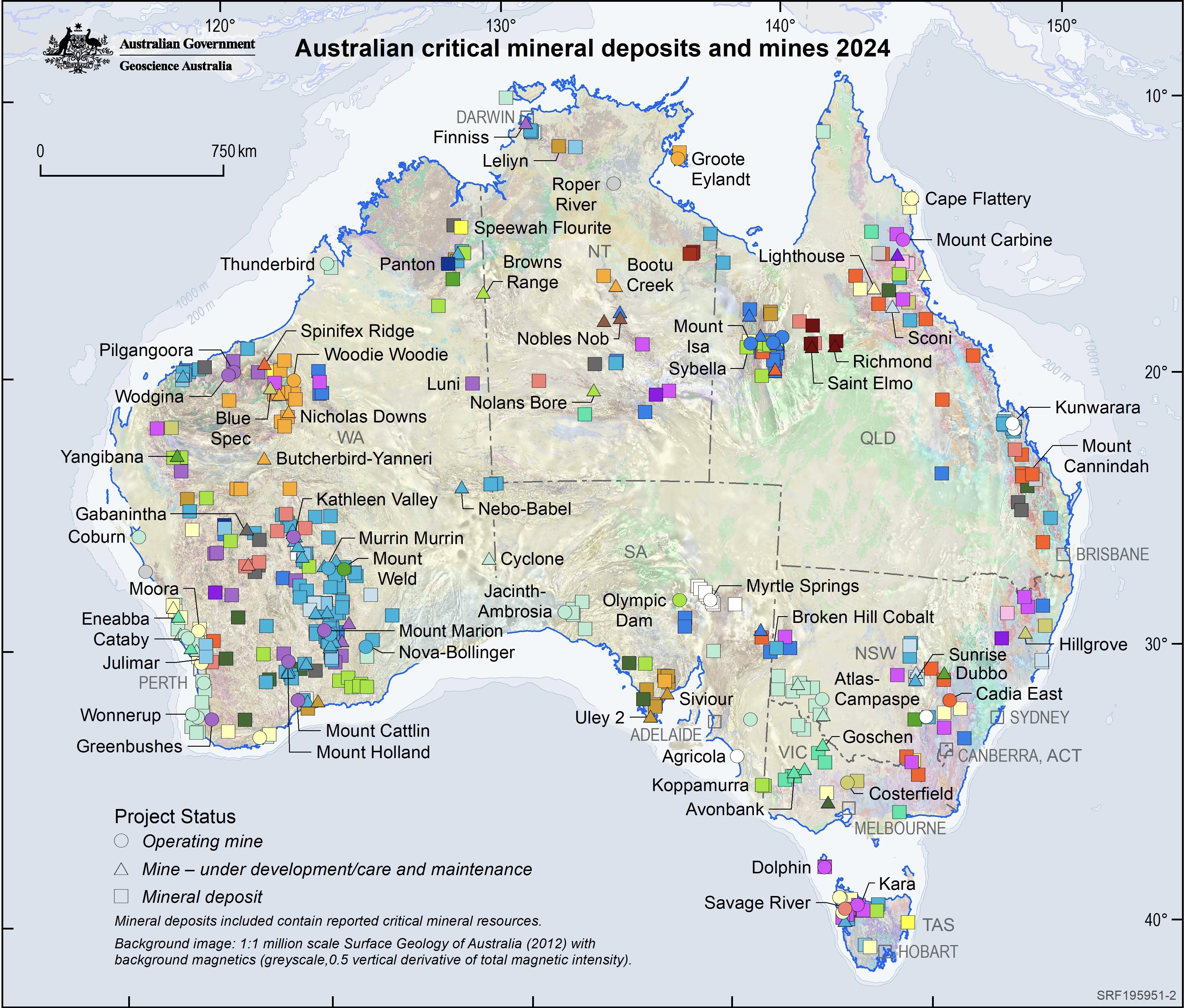
Australian Critical Minerals Map 2025. Image: Geoscience Australia.
The whole value chain
The draft looks for opportunities from geoscience and exploration through to processing, energy and water supply. Bero said companies should share procurement pipelines early so communities have time to prepare and set up businesses.
The draft calls for agreed protocols on how geological, environmental and cultural information is collected, in line with Indigenous data sovereignty. It sets out obligations stage by stage. Exploration consent gets its own defined scope. Communities get access to modelling at feasibility. Ownership and risk allocation are settled before financial close. Construction commitments are enforceable. Operations run under joint governance with direct community access to monitoring data.
Bero said the measures should track delivery. Employment data should capture retention and progression, and procurement data should capture business control and profitability.
"The strategic importance of a mineral does not remove its environmental impacts on caring for Country," he said. "It must really shape the decisions from the outset."
Closure planning should begin at feasibility. Traditional Owners should help define the criteria for rehabilitation and future land use, backed by financial assurance. Bero said responsibility for residual risk must stay clear after closure so communities do not inherit what is left behind.
A job for every party
The draft gives each stakeholder group its own work. Government should fund independent community capability, build pathways to equity and attach measurable First Nations conditions to public project support. Industry should discuss equity "while project design remains open". Investors should examine the quality of consent, governance and any unresolved disputes as part of due diligence.
Success will be measured across five outcomes: economic, governance, capability, Country and legacy. Communities will decide how much weight each one carries.
Closing the implementation gap
Bero said the immediate priority is a standing First Nations implementation mechanism with national and regional reach, run under First Nations governance and backed by secure multi-year funding.
"There is an implementation gap, and communities need accessible support that can stay with them through lengthy project development and changing market conditions," he said.
The mechanism would help communities prepare for projects, find specialist advice, build business cases and connect with suitable capital. It would keep working after agreements are signed, helping communities monitor commitments and manage investments through operations and closure. Each nation would keep authority over its Country, its partners and its decision on whether to take part at all.
Bero, the 2024 Senior First Nations Lawyer of the Year, is Principal of Jaramer Legal and sits on the board of Indigenous Business Australia. He said the strategy remains in draft and invited delegates to help shape it.
"My challenge to relevant stakeholders is to engage early enough for communities to influence the result, resource their participation and support the development of an enduring relationship with First Nations communities," he said. "Success will ultimately be determined by relevant First Nations communities throughout the project and after it ends."