





A partnership between Traditional Owners and a French utilities giant has set in motion what could become Western Australia's biggest water desalination plant.
Construction of the billion-dollar project in the state's North West could begin within two years as project partners prepare to submit plans to the state government's environmental watchdog.
Ngarluma Aboriginal Corporation, water infrastructure developer Legacie and French energy giant Suez have established private company Ngarluma Water to deliver the project, a 150-gigalitre seawater desalination plant at Balla Balla, about 1600 kilometres north of Perth in the remote, water-scarce Pilbara region.
Speaking on day two of the 2024 Pilbara Summit, Legacie Water Infrastructure Developers managing director Daniel Lambert announced the project plan to deliver large-scale water supply to the Pilbara.
He told the audience on Thursday that Traditional Owners, the Ngarluma people, had the right to generate wealth from projects developed on their Country, and that Ngarluma Aboriginal Corporation had equity in the project via an Indigenous Land Use Agreement.
"The Pilbara is thirsty to supply resources, it's thirsty to supply upcoming projects around hydrogen and green steel manufacturing, it's thirsty to supply the growing communities we've heard about, and it's thirsty in terms of potential for the agricultural industry," Mr Lambert said on Thursday.
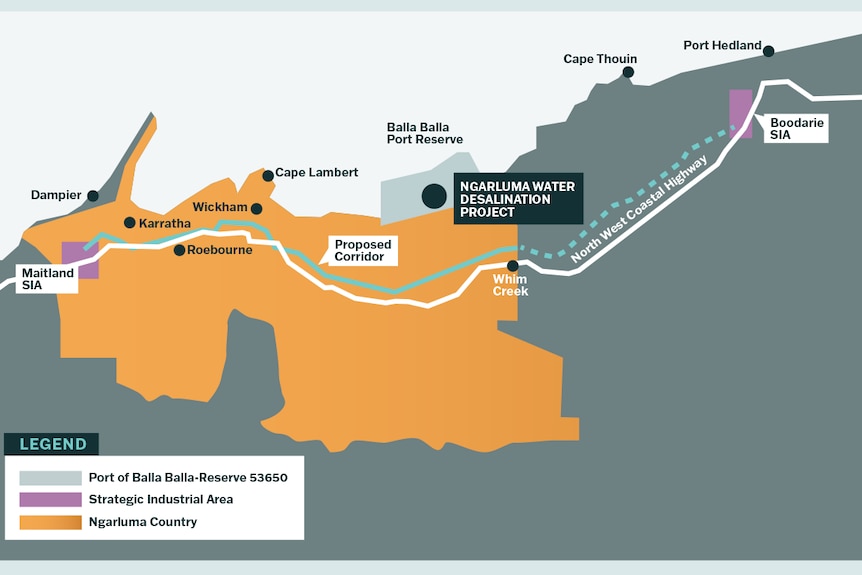
He said the proposed location 10kms west of the Balla Balla River was an ideal location for the project, having access to seawater and proximity to the Maitland and Boodarie strategic industrial areas.
"We're talking to multiple off-takers about how to participate in this project," Mr Lambert said.
He was hopeful the partnership could deliver the large-scale project for the Pilbara.
"We are so excited about a project of this scale, delivering sustainable water, protecting the environment in terms of our groundwater resources," Mr Lambert said.
If construction of the Ngarluma Water project began in 2026, the first water could be produced by early 2029.
Mr Lambert said Legacie was working with Traditional Owners to progress tenure, Native Title, heritage, community engagements and industry liaison.
Legacie CEO, Michael Froud told National Indigenous Times the Ngarluma Water Desalination Project was a collaboration that merged global expertise with deep local knowledge, ensuring the project benefitted everyone involved.
It is the first desalination plant in Australia to be developed in partnership with a First Nations organisation.
"NAC will be an equity shareholder and an active participant in the project, contributing through the Balla Balla Working Group and guiding approvals discussions and the development of offtaker agreements," Mr Froud told National Indigenous Times.
"When the project proceeds to the final investment decision, NAC's equity participation will deliver multi-generational economic and social benefits for the Ngarluma people, ensuring their prosperity and the preservation of Ngarluma heritage and connection to Country."
The development of economically viable and sustainable water supplies was essential to enabling the decarbonisation and diversification of green industries in the Pilbara region.
The Ngarluma Water Desalination Project would significantly reduce the region's reliance on valuable groundwater resources, with project proponents hopeful the it would usher a new era of sustainable development and create substantial economic opportunities for First Nations communities.
"By reducing reliance on groundwater, the project will not only aid in the preservation of a precious resource but will also pave the way for new economic opportunities in the Pilbara," Mr Froud said.
The proposed site benefits from proximity to the North-West Interconnected System (NWIS), the proposed Balla Balla Port export facility, and the Pilbara Energy Pipeline.
It was strategically located to leverage existing infrastructure and support the region's growth.
"It's not just about meeting today's water demands but about building capacity for future development in the Pilbara," Mr Froud said.
Legacie stressed to National Indigenous Times on Friday the partnership agreement with the Ngarluma Aboriginal Corporation was subject to final approval by the Ngarluma community.
Ngarluma Water was designed to service industry through the provision of a 'common user' desalination plant, with early costs estimates between $4b and $5b.
"This will provide up to 150 gigalitres (GL) per annum, catering to the Maitland and Boodarie Strategic Industrial Areas and other key regional stakeholders," he said.
"It is not connected scheme water."
Rio Tinto last year announced plans for its Dampier seawater desalination plant in the West Pilbara, worth $US395 million, at Parker Point, with initial capacity of four gigalitres each year, with the potential to double output in the future.
As part of that project, Rio would also build a supply pipeline to connect to the WA water utility Water Corporation's West Pilbara water supply scheme, for distribution to the miner's communities and operations along the coast.
That proposal development encompasses 57.5 hectares, with most works occurring on previously disturbed land.