




When an ally calls a place by its traditional name, why does it tie some people up in knots?
Operating respectfully on Wadandi Boodja since 2007 is at the bottom of every email sent by Margaret River Discovery Co.
Sean Blocksidge, the sole owner and operator of the award-winning small group tour company is a staunch Indigenous ally who works alongside and promotes the culture of the region's Wadandi Traditional Owners.
During every tour he hosts in Western Australia's Margaret River region, he respectfully shares some pre-European history with his guests. He does the same with his 55,000 followers on Facebook and Instagram.
One of his recent Facebook posts about Wooditjup Bilya, the Indigenous name for Margaret River, has again caused a stir among what Mr Blocksidge jokingly refers to as 'Pauline's Bandits'.
The video shows the river breaking through the sandbank to naturally flow into the Indian Ocean. The post has amassed more than 4,600 likes, 400 comments and 180 shares on Facebook.
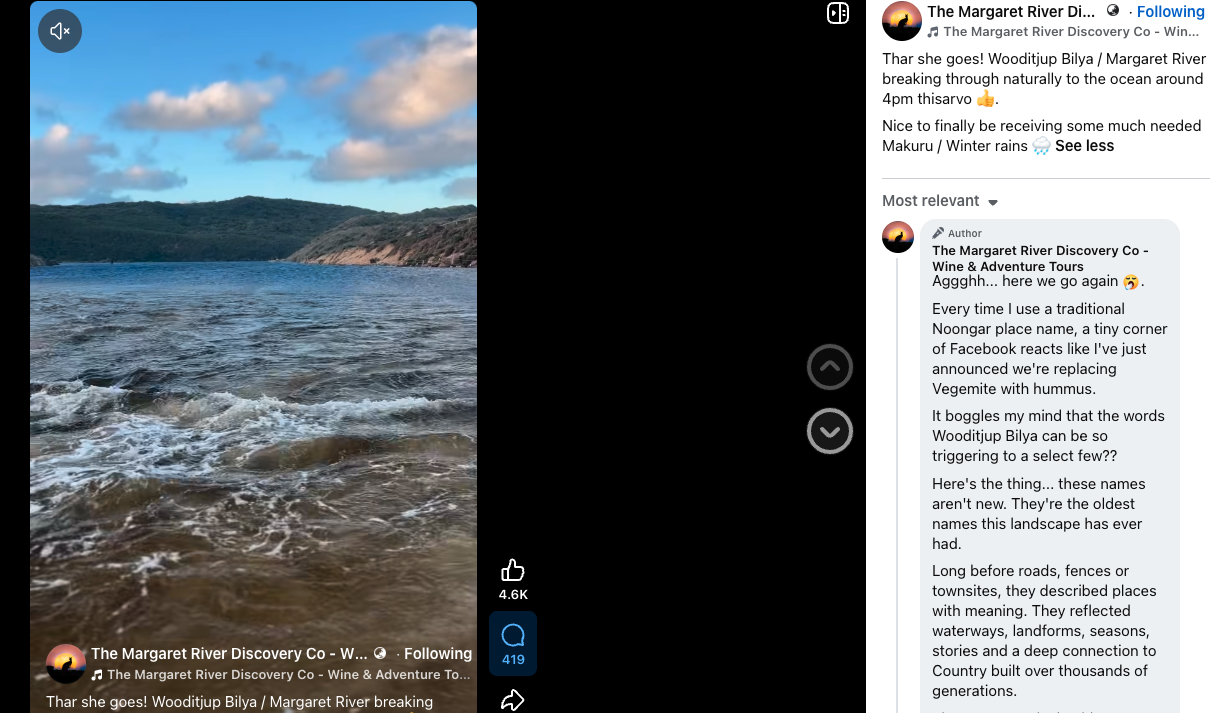
Some of the comments have been nothing short of racist, prompting Mr Blocksidge to post a comment to explain.
"Every time I use a traditional Noongar place name, a tiny corner of Facebook reacts like I've just announced we're replacing Vegemite with hummus. It boggles my mind that the words Wooditjup Bilya can be so triggering to a select few?" he posted.
"Here's the thing... these names aren't new. They're the oldest names this landscape has ever had. Long before roads, fences or townsites, they described places with meaning. They reflected waterways, landforms, seasons, stories and a deep connection to Country built over thousands of generations.
"They're not replacing history. They are history.
"The funny part is that nobody blinks an eye when we use French wine names, Italian food names, or Icelandic volcanoes we can't pronounce. We happily stumble our way through "charcuterie", "bruschetta" and "croissant" without declaring civilisation has collapsed.
"But suddenly Wooditjup is apparently a bridge too far.
"What do we actually lose by saying it? Nothing.
"What do we gain? A richer understanding of this incredible landscape. Respect for the people who cared for this Country for tens of thousands of years before Europeans arrived. And, perhaps most importantly, we help keep an ancient language alive instead of letting it quietly disappear. That seems like a pretty good deal.
"So, if hearing the original name of a place causes your blood pressure to spike... it might be worth asking yourself why a word that's been here for thousands of years is somehow more offensive than your reaction to it. If an Indigenous place name is the biggest thing ruining your day... I'd gently suggest the place name probably isn't the problem [wink emoji].
"Personally, I'll keep saying Wooditjup Bilya. It's a rippa name, it belongs to this place, and I reckon the landscape deserves to be known by more of its story, not less."
Western Australian Indigenous Tourism Operators Council (WAITOC) is the peak representative for Aboriginal tours and experiences in Western Australia.
WAITOC chief executive Robert Taylor said traditional place names are not just words on a map.
"Traditional place names are living connections to Country, culture and thousands of years of knowledge," Mr Taylor said.
"By using these names, we're acknowledging the world's oldest living cultures and helping to keep language, history and connection to Country alive.
"Understanding a place begins with knowing its story, and traditional names are an important part of that story."
When National Indigenous Times spoke to Mr Blocksidge about the post, he said the response had been overwhelmingly positive.
"It's easy to forget because social media has a funny way of handing the microphone to the angriest and most miserable people rather than the majority," he said.
"Every time a post reaches hundreds of thousands of people, there's a small group that seems determined to hijack the conversation. They're loud, but they're certainly not representative.
"I'd be lying if I said it never gets under my skin. But I also remind myself that outrage is amplified by algorithms."
Mr Blocksidge said he'd learned not every comment deserves a reply, and that some people genuinely want a conversation, while others just want an argument.
"Using Noongar place names doesn't take anything away from anyone. If anything, it reconnects us with the most significant chapter in the story of the place we all love. And it acknowledges that the history of this place didn't begin with European settlement," he said.
"The beautiful thing is that curiosity is contagious. Once people understand why these names matter, most embrace them. People are far more open-minded than social media sometimes makes us believe."
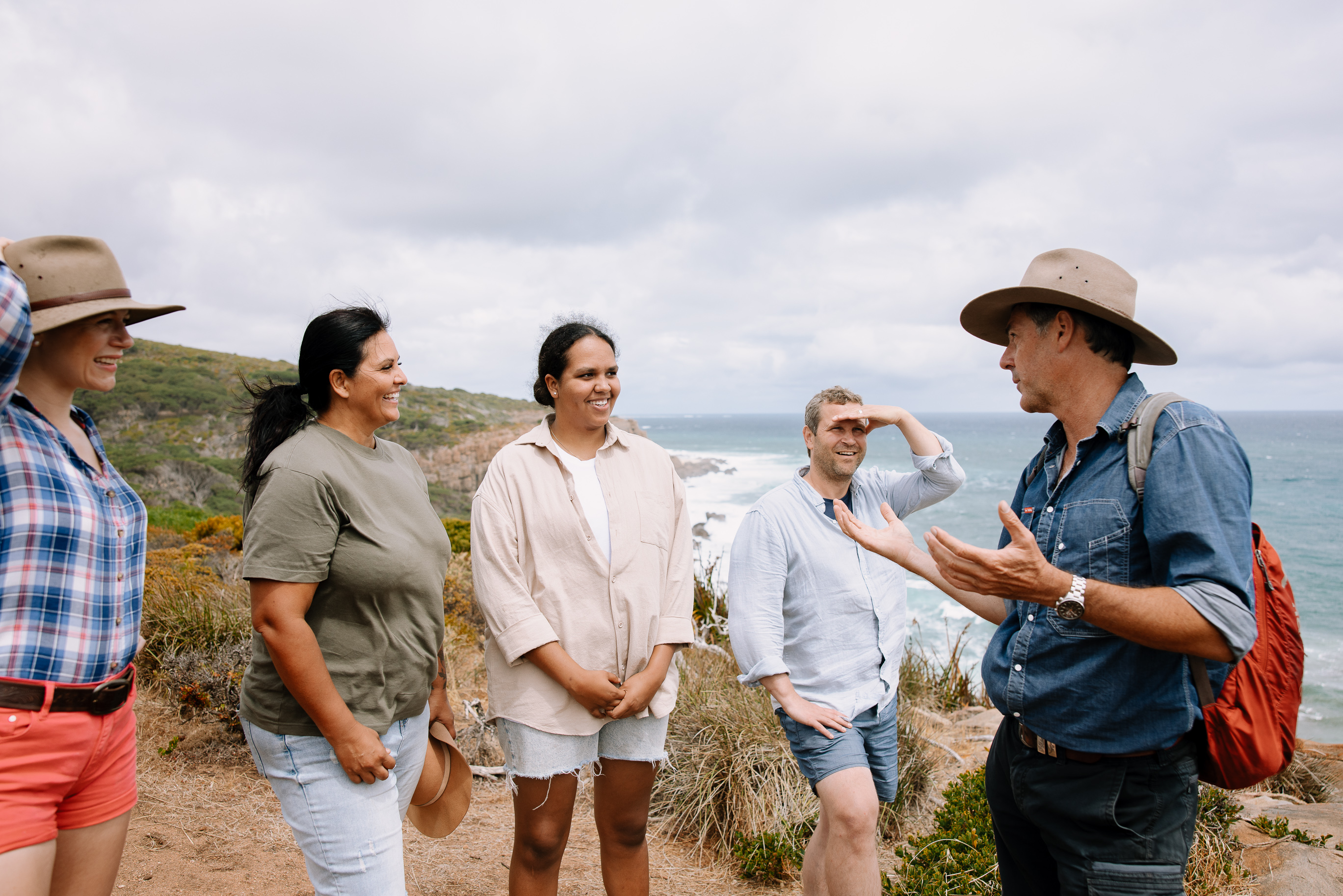
Sitting on the rocks admiring the view of the Wilyabrup Cliffs and ocean, Mr Blocksidge reminds guests that people have been sitting on those same rocks for tens of thousands of years.
"I love it when the penny drops. You can see it on people's faces as they consider that they are on ancient Country that has been inhabited for thousands and thousands of years, it's a beautiful thing," he said.
For the past 17 years, Margaret River Discovery Co has been named Tripadvisor's number one tour in Western Australia's south west and was named Best Tour Operator at the WA Tourism Awards in 2024 and 2025.
Mr Blocksidge takes guests beyond the cellar door to include a unique adventure in his luxury Range Rover.
"We paddle the actual Margaret River, hike remote sections of the Cape to Cape Track, venture into wild bushland by 4WD, and share wine in a private barrel room," he said.
"Every moment connects guests to terroir, taste, and transformation.
"I'm not chasing scale — I'm chasing soul. My belief is simple: when done well, small tourism leaves the biggest impact."