




Key points:
- The 2026 National Indigenous Empowerment Summit was held in Magandjin / Brisbane
- The Summit focusses on Indigenous-led solutions in education, employment and economic development, with self-determination, cultural authority and practical action at the centre
- Speakers stressed that economic development must begin with respect for place, and that Indigenous knowledge must be protected, not extracted
The 6th National Indigenous Empowerment Summit has focused on Indigenous-led solutions in education, employment and economic development, with self-determination, cultural authority and practical action at the centre.
AUAHA founders Andre (Te Arawa, Tainui, Taranaki) and Gaylene (Ngati Porou) Ahipene used their keynote speech to place Te Ao Māori (Māori people) at the centre of self-determination and economic development.
AUAHA, a Māori cultural services and solutions enterprise based in Australia, was formed after the couple identified a need for cultural identity and reclamation among Māori living abroad.
Mr Ahipene said Māori self-determination began with language.
"It all centres around Te Ao Māori, the Māori language," he said.
The keynote framed culture not as an addition to development, but as knowledge, design, story, language, identity and economic power.
It also linked cultural value with economic value, arguing that inherited knowledge and cultural practice were assets for future economies.
Mr Ahipene said AUAHA's work required confidence to speak from a Māori position.
"In terms of the work that we do, it's really about having that knowledge, having that insight and having the courage to be able to share that as well," he said.
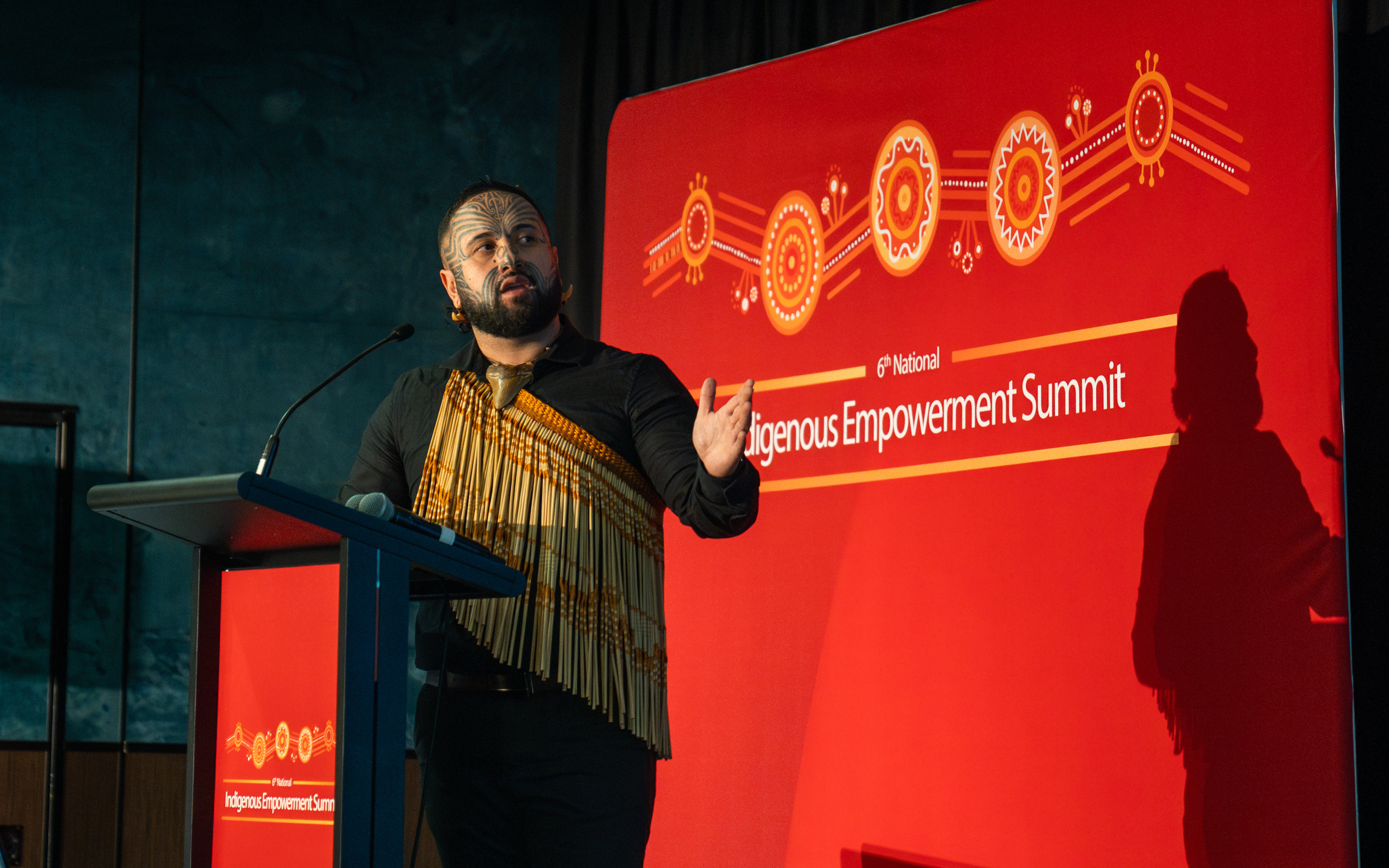
The presentation placed mana motuhake (self-determination) within a wider discussion about cultural authority and Indigenous enterprise.
Mr Ahipene said the term spoke to identity, pride and direction.
"If we centre that on the language component, we look at terms like mana motuhake," he said.
"Our own pride, our own integrity as a people, as individuals, it sort of leads us into that direction."
Capability is not about making Indigenous businesses more Western, but giving people tools to grow without leaving themselves behind.
That included business skills, financial confidence and governance knowledge, while keeping tikanga, cultural safety and community responsibility at the centre.
Ms Ahipene said she saw shared values between Māori and Aboriginal and Torres Strait Islander peoples during the summit.
"The similarities that I see between us, the Māori people and our Mana Whenua (Cultural authority), or our Indigenous people here, is really the respect," Ms Ahipene said.
"The respect that they have for their Elders, for the knowledge that has been passed down, you can see that it's been instilled in them really deep and they still live in it."
"Even though we come from different lands, different places, we are the same people with the same struggles and the same fights and the same victories also," Ms Ahipene said.
Mr Ahipene added strong communities were built through strong people, and economic development needed to begin from that base.
"I spoke about stronger people build stronger communities," Mr Ahipene said.
"They are the anchor point to our people doing well."
The keynote also placed Country, cultural authority and intellectual property at the centre of economic futures.
Economic development must begin with respect for place, and that Indigenous knowledge must be protected, not extracted.
Mr Ahipene said Māori and First Nations peoples in Australia could learn from each other by normalising culture in shared spaces.
"If we continue to indigenise every space that we go into, if we continue to recognise and see each other in our practices, in spaces other than our own ancestral lands, then it's really about prioritising just normalising culture," Mr Ahipene said.
"We have to understand and be open to working with our non-Indigenous people," Mr Ahipene said.
Ms Ahipene said the lesson for Indigenous communities was to stand firmly in identity.
"I think the biggest lesson that we can learn from one another is stand true in who we are," Ms Ahipene said.
"Even if that practice that you're doing, you only know, it's just a really small one word, just use it and grow and be strong enough to just take one step at a time."
For AUAHA, that message was tied to a broader vision of Indigenous enterprise as stronger peoples, safer systems and futures where children can stand inside culture.