




Key points:
- Australia's only 100 per cent Indigenous biosecurity workforce guards a border just 3.5km from Papua New Guinea.
- Regional Authority chair says 123 home loans since 1994 is nowhere near enough.
- A school-run ferry, a fisher's new outboard, and a buy-back plan for the Torres Strait's most valuable catch.
George Nona told a Meanjin / Brisbane audience on Wednesday that the single change that would most help the Torres Strait is a Torres Strait Islander voice inside parliament, and that he is already working to make it happen.
"It's in my list to sit with the prime minister," the Torres Strait Regional Authority chair said, when asked at the National Indigenous Empowerment Summit what one thing he would change to assist the Torres Strait. "For us.. there's always giants, and I can tell you that Indigenous are giant slayers."
Nona was elected TSRA chair in 2025 and represents Port Kennedy on the authority's 20-member community-elected board. He told the summit the TSRA had lifted its Aboriginal and Torres Strait Islander workforce from 70 per cent when he started to 84 per cent, and was aiming for 100.
The authority, a federal statutory body established on 1 July 1994, is the lead Commonwealth agency for Indigenous affairs across the Torres Strait. It runs eight programs spanning governance, healthy communities, fisheries, culture, environmental management, safe communities, economic development and regional infrastructure, covering five island clusters and 17 inhabited islands between the Australian mainland and Papua New Guinea.
Nona returned repeatedly to fisheries, where he set out an ownership agenda. Torres Strait Islanders and Aboriginal people own 100 per cent of the finfish and hand collectables fisheries in the region, and 66 per cent of the tropical rock lobster fishery.
"We are now looking at buying everything back," he said. "We're going to come back and be 100 per cent owners of what we actually own."
He said the authority was in discussions to export live product from the Torres Strait directly into international markets, "to cut out the middle people" pointing out that Ngurupai / Horn ISland International Airport is the closest international terminal to northern neighbours. He reminded the audience that the nearest Torres Strait Island to Papua New Guinea, Saibai, is seperated by just 3.5kms of ocean - a distance that is swimmable.
Nona pointed to TSRA-backed enterprises as proof the model works. Through the authority's Business Growth Package, Iama (Yam Island) operator Loban Marine, founded by Yen Loban, secured a loan for a wheelchair-accessible vessel and a grant for a tractor, trailer and outboard motors. The business now holds a contract to ferry schoolchildren from Ngurupai (Horn Island) and Muralag (Prince of Wales) to Waiben (Thursday Island) through to 2030. Under the WAPIL project, Iama commercial fisher David Baragud became the first to receive a replacement-asset grant, covering safe, fit-for-purpose gear delivered with funding from the National Indigenous Australians Agency.
"When you've got reliable gear, you can focus on fishing," Baragud said. "It gives you peace of mind when you're out on the water."
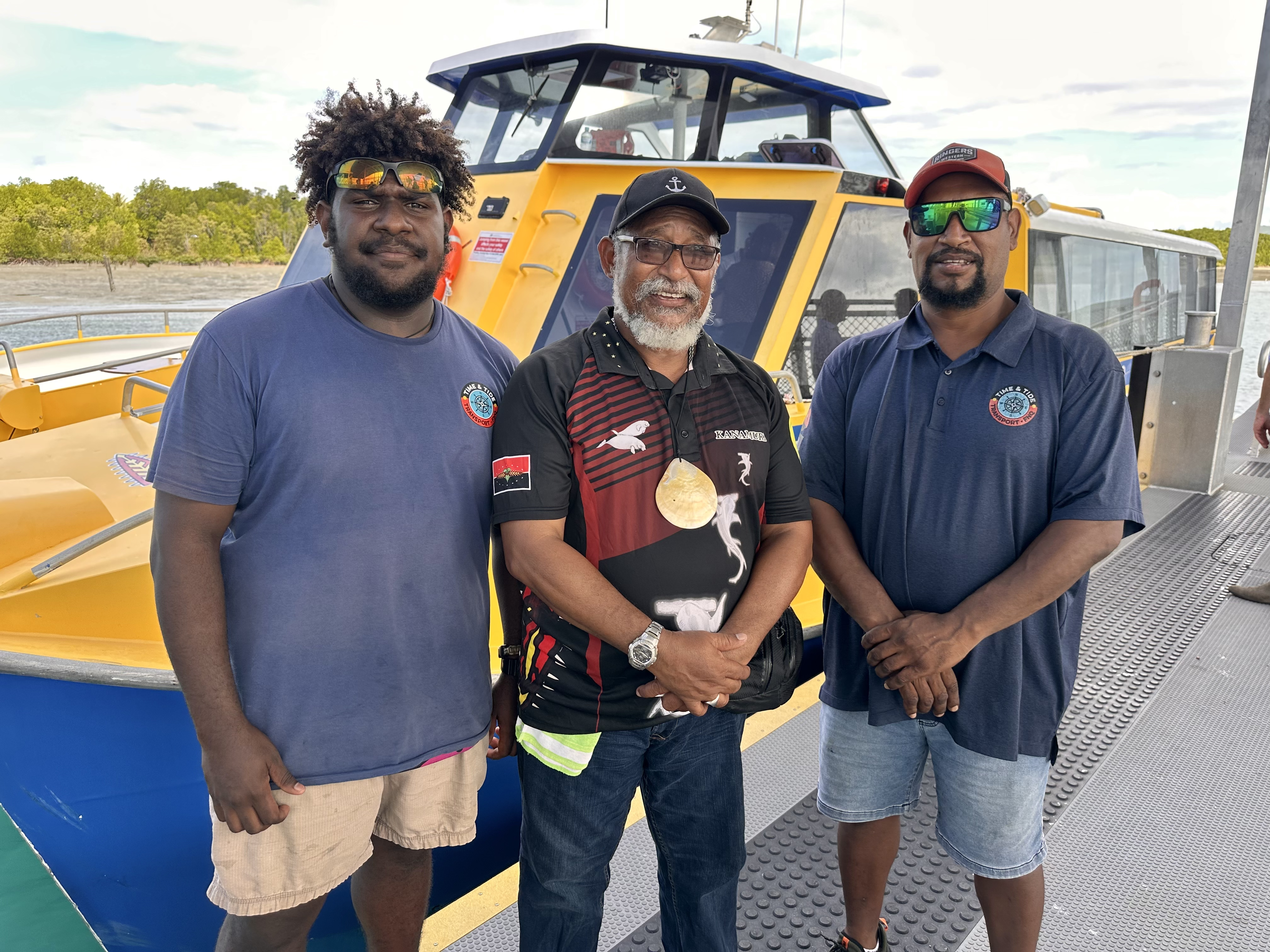
The authority has backed other transport ventures on the same waters. Time and Tide, a 51 per cent Aboriginal-owned bus and ferry company servicing Ngurupai (Horn Island) and Waibene (Thursday Island), began operating in early 2025 after Thursday Island Elder Willie Wigness and Elders from neighbouring islands and Cape York met the TSRA for funding support. The business now runs two vessels and employs a team of twelve, with a plan to transition to 100 per cent Indigenous ownership once it is stable.
On home ownership, Nona said the TSRA had delivered 123 loans since 1994, with 10 active loans valued at $1.8 million, a record he described as inadequate.
"Only 123 since 1994. That's not much," he said. "To me it's not enough," linking the low numbers to land tenure on the outer islands while saying the issue had been raised directly with the Premier.
Much of his address drew on his own childhood on Badu Island, without air conditioning, mains water or a generator. He described carrying water from a well and collecting firewood with his brothers so his mother could cook.
"That pain that I've carried for so many years," he said. "If you're in any organisation and you provide services, I really challenge you to look at the pain that you've gone through. When you come into the position where you are now, you can turn the game around."
He recounted his first meeting with TSRA program managers. "If you can't provide any services to my people, see that door there? You go find an exit, take your things and get out of here."
A proud Badu, Saibai, Mua and Iru man with more than 35 years in the Commonwealth public service across Customs, Border Force and biosecurity, Nona is a senior pastor and youth and sport volunteer. He pointed to the Torres Strait's biosecurity workforce, which he said is 100 per cent Indigenous, as proof of what affirmative recruitment delivers.
He closed on unity across the country. "Every tribe that fills all the puzzle pieces of Australia and Tasmania, we all need to come together and we need to move with one voice. Not separate voices, because we won't be heard."