





An Indigenous-led collaboration in Far North Queensland is laying the groundwork for what could become Australia's first commercial giant freshwater prawn industry, blending ancient knowledge with modern science to unlock jobs, food security and economic opportunity across the north.
At the heart of the project is Hope Vale Foundation, a community development organisation seeking to commercialise Australia's native giant freshwater prawn, Macrobrachium rosenbergii.
While the species thrives in northern Australian rivers and supports a global demand worth more than USD $5 billion, Australia has never developed a commercial industry of its own.
That gap is not due to a lack of demand or environmental suitability, but a technical barrier which has stalled progress: the absence of reliable hatchery protocols adapted to Australian conditions.
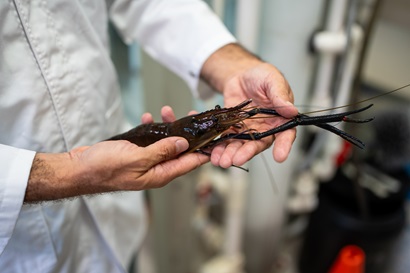
Through the Queensland Government-funded Regional University Industry Collaboration (RUIC) program, delivered by CSIRO, Hope Vale Foundation is partnering with researchers at the University of the Sunshine Coast to remove that barrier and create a pathway for Indigenous-led aquaculture enterprises.
Inside the University of the Sunshine Coast's aquaculture facility, broodstock collected from Cape York waterways are being carefully bred and monitored. Each tank represents a step toward solving the complex challenge of breeding and raising giant freshwater prawns through their early life stages, from larvae to juveniles.
"We are leading a first-of-a-kind, Indigenous-led aquaculture initiative focused on scaling up giant freshwater prawn production right here in Far North Queensland," Hope Vale Foundation's Tony Matchett said.
"Our focus is commercialising a native, climate-adapted protein with strong global demand, while creating real opportunities for our communities."
The technical work is led by Associate Professor Tomer Ventura, whose expertise with the species spans more than seven years of research. His previous work includes co-inventing a patented all-male production technology, a significant breakthrough for commercial efficiency.
Now that knowledge is being adapted to Australia's unique environmental conditions, Dr Ventura and his team are testing water temperature, salinity, nutrition and growth rates, documenting survival through each developmental stage. The aim is to create a practical, repeatable blueprint which future hatcheries can follow.
For Hope Vale Foundation, the project is about more than prawns. It is about Indigenous leadership in emerging industries, regional employment and long-term food security.
"We are responding to two major challenges," Mr Matchett said. "The global protein gap and food insecurity in remote communities. By combining cultural knowledge with cutting-edge science, we're creating a low-emission, water-efficient model that can be scaled across northern Australia."
The vision includes derisking production to enable commercial investment, developing training and career pathways for an Indigenous aquaculture workforce, and strengthening economic resilience in regional and remote communities.
Once hatchery production is proven, juvenile prawns could supply grow-out operations across northern Queensland, the Northern Territory and Western Australia, using pond-based or recirculating aquaculture systems suited to local conditions.
RUIC program Senior Facilitator, Luke Deacon, said the initiative reflects the program's intent to connect regional universities with industry-led innovation challenges.
"By supporting early-stage collaboration and linking communities with the right research capability, we help turn ambition into evidence-based opportunities that industry can build on," he said.
Hope Vale Foundation retains commercial leadership of the project while accessing scientific expertise and infrastructure that would otherwise be out of reach. Training frameworks are being developed alongside the research, ensuring knowledge stays on Country and translates into lasting capability.
As the broodstock continue to establish and the data builds, the team is looking toward long-term scale.
"By closing the life cycle and validating production, we are positioning ourselves for strategic partnerships and national expansion," Mr Matchett said.
"Our goal is that by the time the world comes to Queensland for the 2032 Olympics, Australian native freshwater prawns will be on the menu, led by the communities who have cared for these waters for generations."
For now, the work continues tank by tank, cycle by cycle, laying the foundations for a future industry rooted in Country, culture and Indigenous leadership.