




"We've been talking about better access to capital for thirty-odd years. To be honest, I don't think we're there yet."
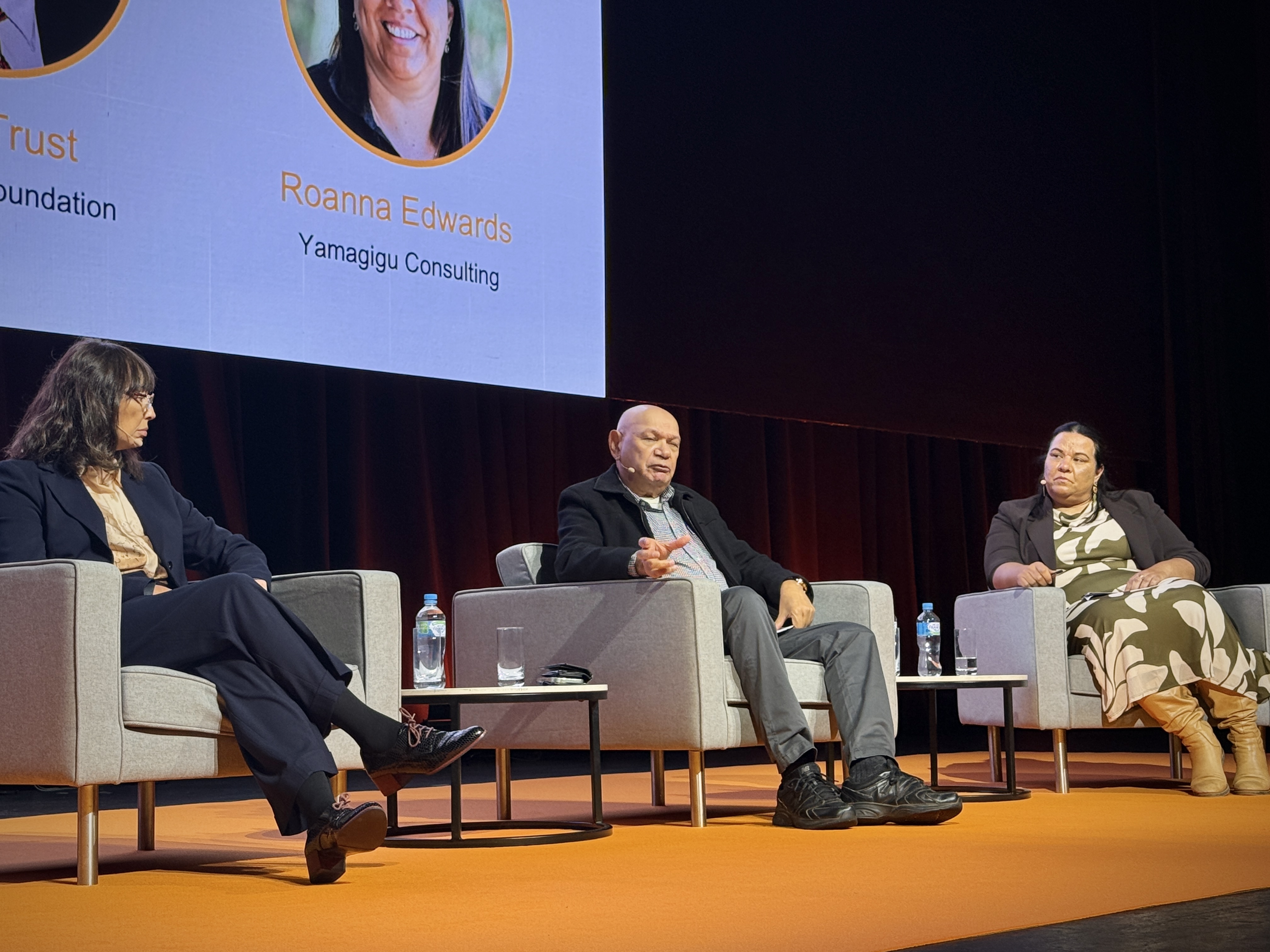
Leah Armstrong, interim director of the Australian National University's Centre for Indigenous Economic Transformation, delivered that verdict at Supply Nation's Connect 2026 conference in Boorloo (Perth), on a panel that put finance, and the institutions that control it, at the centre of the fight for Indigenous economic self-determination.
Yamagigu Consulting's Roanna Edwards presented the BlakPrint report, produced by the Northern Territory Indigenous Business Network with Yamagigu and Deloitte Access Economics, which found Indigenous businesses added $3.4 billion to the Northern Territory economy in 2024-25, a tenth of everything the Territory produced and within $75 million of the entire public administration industry. The sector employed 11,600 full-time equivalent workers, more than the Territory's construction industry, and contributed $843 million in tax across Territory and Australian governments.
"Investing in this sector is no longer just a nice thing to do, it is highly responsible economic policy," Ms Edwards said. "Our business sector is not something that sits on the fringes. It is at the heart of this nation and its economy."
Noongar Chamber of Commerce and Industry chair Gordon Cole facilitated, opening on the banks of the Derbarl Yerrigan where his grandfather was born, and Wunan Foundation executive chair Ian Trust completed the panel.

The discussion kept returning to the morning keynote from KingKira Group founder Tammy O'Connor, knocked back for a $40,000 car loan on her way to financing heavy machinery. Asked what a narrative of Indigenous economic success looks like, Ms Edwards answered: "It looks a bit like Tammy, right?"
Ms Armstrong said mainstream financial institutions had spent years on procurement targets, Reconciliation Action Plans and cultural capability while their risk appetite barely moved.
"Mainstream institutions still want an Indigenous business to fit into a traditional mainstream mould to access capital. Because those core systemic changes aren't happening, we need to build a different system, a system that recognises and assesses the risk of Indigenous businesses differently."
She put the sector's capital demand at about $800 million a year, based on survey work with Yamagigu at First Australians Capital, and cited Indigenous Business Australia's estimate that $100 billion will be needed for major projects requiring First Nations equity participation.
The model she wants exists in Canada, where the National Aboriginal Capital Corporations Association has helped build an architecture running from community lenders offering start-up capital to the First Nations Financial Authority and its billion-dollar loans. Ms Armstrong is advising the Commonwealth on similar reforms through the First Nations Economic Partnership, alongside the Coalition of Peaks and Treasury.
"Procurement has done great work over the last 10 to 15 years, but procurement needs to be part of a larger fiscal and financial architecture to truly accelerate progress over the next five years," she said.
Mr Trust, who has spent four decades driving economic development in the East Kimberley, set the stakes in a single statistic.
"In 1967, the crime rate was below the state average. Today, it is 200 to 300 per cent above it. You've got to ask the question: what happened to cause that?"
His answer is jobs, business, assets and a growing Indigenous middle class.
"In a country as wealthy as Australia, there should be a huge effort to build the middle class. Yet there is still an element in our community that doesn't see this as a positive thing. They think we're abandoning our cultural values to some extent, which is not the case. I think that's an issue of leadership, Aboriginal leadership selling our story."
He pointed to the t-shirts worn at Kimberley Land Council meetings that read "Walk in Two Worlds".
"That's exactly what we've got to do. But I don't think we're very good at telling the second version of that story."
At ground level, he said, the capital gap decides who sleeps at night.
"I know a guy out there who told me, 'I can't go to sleep because I'm worrying about how I'm going to pay my men, and worrying about where the next contract is coming from'. It is a very tenuous existence trying to run a business directly."
He called on state governments to break up major contracts so smaller Aboriginal operators could tender with industry partners.
"If they are upgrading the road between Fitzroy Crossing and Derby, and the contract is worth $100 million or $200 million, why can't they carve off a portion of that for Aboriginal operators to tender for with an industry partner?"
"I really connected with Tammy's story about getting rejected for a $40,000 car loan," Mr Cole said. "It is deflating and devastating when you think you've made it, only to be rejected. I grew up expecting not to get loans, but when you finally do, it feels incredible."
The same assessment, he said, waits in every meeting room: "You walk into these corporate or government offices and you can see a giant question mark over your head. They just look at you as a risk."
Ms Edwards said the Indigenous Procurement Policy had been a game changer, and how relevant it proved depended on the contract managers who apply it: on nervousness about newer businesses, protection of comfortable incumbent relationships, and ignorance of what the policy allows.
"A policy is only as good as how it is used. The policy allows for great things, but in practice, we don't see them occur."
She also challenged the tender test itself.
"I'm not sure there is even a formal, agreed-upon definition of what value for money actually means. I can guarantee that if there is a definition sitting within government, it doesn't align with our values. It doesn't account for the ripple effect that a dollar spent with an Aboriginal business has compared to a non-Indigenous business."
Asked what non-Indigenous companies could do, Mr Trust wanted satisfied clients to back emerging Aboriginal contractors with testimonials; Ms Armstrong wanted longer-term contracts: "A one-off contract gets you in the door, but a long-term contract is what you can take to a bank or financial institution to secure the working capital you need."
"Stop competing with us for work that is meant for our mob," Ms Edwards said. "We need mainstream organisations to have the maturity to look at a tender and ask, even though I have bills to pay and need to win business, is an Aboriginal business better placed to deliver this work? If the answer is yes, then have the courage to stand back and make space."
On equity in renewables and mining, Ms Edwards said developers were abandoning the assumption that Indigenous equity meant a free-carried, passive interest, and starting to realise the sector had "mature, highly capable Aboriginal businesses with our own capital ready to stump up to be genuine, active equity partners".
Ms Armstrong closed the panel looking outward, to the Indigenous Peoples Economic and Trade Cooperation Arrangement linking Indigenous businesses across Australia, Aotearoa, Canada and Chinese Taipei.
"We have been traders internationally for 65,000 years, and the next step is taking our businesses globally," she said.
"Articulating our contribution to the Australian economy in GDP figures is great, but building our own value-led economy is what truly matters."