




- The subcontractor that grew from three staff to 70 on one Perth alliance
- Why Georgiou will reward subcontractors who match its Reconciliation Action Plan
- The coffee meeting that won a Noongar electrical firm a multi-million-dollar package
Georgiou Group has committed to spending 2 to 4 per cent with Aboriginal and Torres Strait Islander businesses on identified projects under a Stretch Reconciliation Action Plan it launched on 30 September.
The 2026 to 2029 plan also sets Aboriginal and Torres Strait Islander employment targets of 3 to 8 per cent across identified projects. Targets for both measures will be set project by project, based on scope, client requirements, location and the availability of capable First Nations suppliers and workers.
Georgiou says the Stretch RAP moves the company from commitment to accountability.
"Our Stretch RAP marks an important step forward shifting from commitment to greater accountability and measurable impact," chief executive Gary Georgiou said.
"Reconciliation at Georgiou is not a standalone initiative; it's embedded in how we work every day, across our projects, partnerships and communities."
Reconciliation Australia chief executive Karen Mundine congratulated the company on its "formal commitment to reconciliation".
"Georgiou Group is helping to build a more inclusive industry, one that values First Nations knowledges and participation," she said.
The subcontractors who grew with it
The plan's case studies show what those percentages look like on site.
Totem Civil Services, a fully Aboriginal-owned business, won its first major engagement on Georgiou's Tonkin Gap Alliance in Perth. Additional scopes of work followed.
Totem's workforce grew from three employees to a peak of 70, and its annual turnover rose from about $600,000 in 2021 to just under $11 million.
Oaks Civil Construction joined Georgiou on Tonkin Gap in 2020 as a traffic management provider, then moved on to the Leach Welshpool Alliance in 2021.
In 2022, a five-week pre-employment program on Tonkin Gap took 14 trainees through. Twelve finished with nationally recognised qualifications in infrastructure and traffic control. Led by Jarrad Oakley-Nicholls, the 100 per cent Aboriginal-owned business has since moved into civil construction through Oaks Rail and Civil.
Noongar electrical business Mallee Karlip met Georgiou at a Waalitj Hub Blak Coffee event in November 2023.
Directors Jay Collard and Matt Guy had worked mostly on small industrial and residential jobs. Georgiou helped the business build a capability statement and an online presence.
Mallee Karlip then pitched at the Mandurah Estuary Bridge Duplication Open House and won the electrical package against several more established contractors. It was the firm's first multi-million-dollar project.
Georgiou first ran the Open House model on Tonkin Gap in 2021. At each session, Aboriginal businesses meet the engineers, estimators and package managers who let the work.
The company has since run Open Houses on the Mandurah bridge, the Alkimos Pipeline Alliance and the Reid Highway Grade Separations, and it added Indigenous Business Training in 2025.
The training covers commercial and procurement management, risk, quality and safety.
Pushing the plan down the supply chain
The Stretch RAP extends Georgiou's commitments to its subcontractors. Among its actions are a "subcontractor contractual reward for RAP alignment" and cultural awareness sessions opened to subcontractors.
By July 2027, Georgiou will set up a business mentoring program to help external stakeholders develop their own RAPs. By the same date, it will have standard commercial engagement templates for working with Aboriginal and Torres Strait Islander businesses.
It will also partner with two civil construction companies, including BMD and DM Civil, and with the Civil Contractors Federation and clients such as Main Roads Western Australia.
A full Aboriginal and Torres Strait Islander procurement strategy is due by July 2029. By then, 75 per cent of all staff are to have completed formal, structured cultural learning.
Culture, Community, Commercial
The plan sits on a model Georgiou calls the 3Cs: Culture, Community and Commercial. The company introduced it in 2021, drawing on its First Nations partner Yurra.
In 2023 it set up a working group for each pillar. Each group reports quarterly to a RAP committee chaired at executive level. Aboriginal and Torres Strait Islander representation is built into both the working groups and the committee.
Its partners span all three pillars. Kambarang Services and its founder Danny Ford have worked with Georgiou since 2011, starting with cultural immersion workshops for the leadership team on Wadjemup.
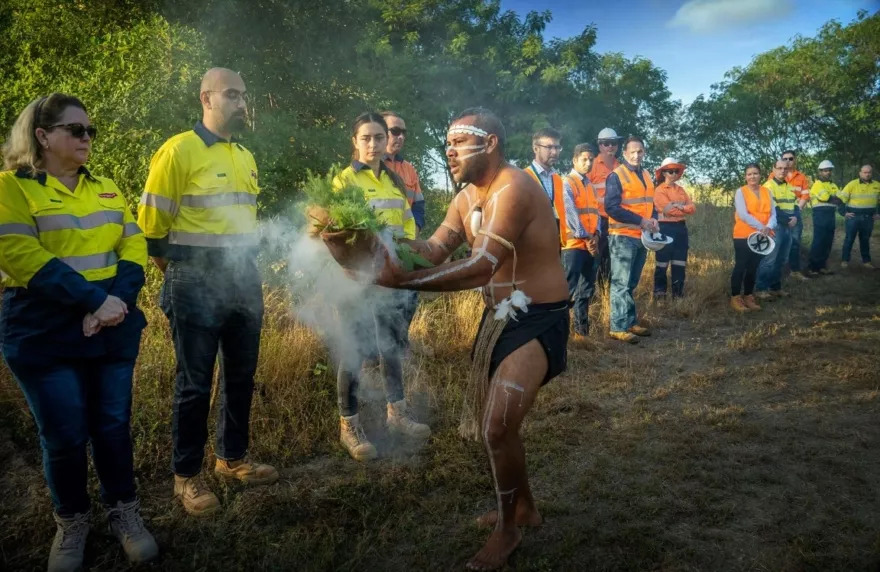
Winjan Aboriginal Corporation in Mandurah led smoking ceremonies and provided Heritage Monitors on the estuary bridge project. In 2026, the Madalah partnership produced Georgiou's first Indigenous Engineering Cadet, Curtin University student Daenah Blackley.
Georgiou will report publicly against the plan every year and submit a traffic light report to Reconciliation Australia when the plan ends in July 2029.
Founded in 1977 as Direct Drainage in North Perth, Georgiou now employs more than 900 people across Western Australia, New South Wales, Queensland and the Northern Territory.
It has been part of European construction group STRABAG since 2025. It says it was the first construction company in Australia to have a RAP endorsed by Reconciliation Australia, in 2011.
"We're proud of the progress we've made, but we know there's more to do," Mr Georgiou said.
"Together with our people and First Nations partners, we remain focused on creating lasting opportunities, strengthening relationships and continuing to walk forward as equals."