



Every October, Indigenous Business Month asks us to celebrate Aboriginal and Torres Strait Islander enterprise. This year's theme is Local and Connected, and here in the Goldfields that theme describes how we already work.
As CEO of the Goldfields Aboriginal Business Chamber, I see the same truth every week: when Aboriginal people own businesses, communities gain choices. They gain jobs on Country, money that stays local, and a stronger voice in the decisions that shape our region.
That is what Indigenous economic development is really about. It is not charity or a compliance box. It is self-determination, wealth creation and enterprise growth, built on three foundations: land and assets, procurement, and genuine business partnerships.
Business is a tool for self-determination
Self-determination means Aboriginal people making the decisions about our own lives, lands and futures. Economic independence is a big part of that. It is hard to have a real say if you have no economic power.
An Aboriginal-owned business does more than make a profit. It decides who gets hired and trained, which young people get a first job, and how culture is respected on site. Profits can be reinvested in family, community and Country, on our terms.
That is why ownership matters. A business that is Aboriginal-owned and controlled keeps decisions and wealth in Aboriginal hands. Over time, that builds the intergenerational wealth.
Land and assets are the foundation
The Indigenous estate now covers about 70% of Australia's land area, according to ABARES. That includes land that is Indigenous-owned, land under Indigenous management, and land covered by native title or Indigenous Land Use Agreements.
In the Goldfields, native title and land use agreements sit alongside some of the richest mining country in the world. These rights give Traditional Owners a seat at the table when resource projects are negotiated.
The challenge is turning rights into lasting wealth. Land and agreement benefits work best when they are used to build assets that last: businesses, equipment, property, skills and investment funds. A grader, a fleet of trucks or a trained workforce keeps earning long after a single payment is spent.
The opportunity is to connect Traditional Owner groups, prescribed bodies corporate and Aboriginal businesses, so that the value of land and agreements flows into enterprise and stays in the region.
Procurement opens the door
Procurement policy is one of the most powerful tools we have, because it turns government and industry spending into Aboriginal business growth. In 2024-25, WA Government agencies awarded a record $442 million in contracts to Aboriginal suppliers, 6.82% of all contracts and well above the 4% target (WA Government).
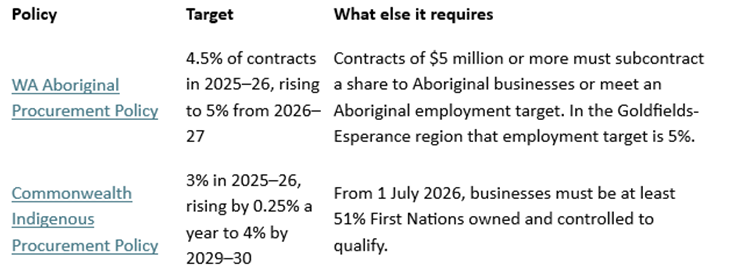
That 51% rule matters. It is designed to stop "black cladding", where a non-Indigenous company uses a token Aboriginal partner to win work. Real ownership means real control, and real benefit for community.
Targets alone do not build businesses, though. Aboriginal businesses need to be ready, visible and connected to the people writing the contracts. That is where local networks make the difference.
Partnerships that share power, not just logos
The best partnerships between Aboriginal and non-Aboriginal businesses share risk, reward and decision-making. The worst put an Aboriginal name on a tender and leave the community with nothing.
A genuine partnership looks like this:
- The Aboriginal partner has real ownership and a real say in how the business runs
- Skills, systems and equipment are transferred, so the Aboriginal business can grow on its own
- Local people are employed and trained, not just counted
- The relationship lasts beyond a single contract
One of our members shows what this can look like. Kai Rho Contracting, a 100% Aboriginal-owned mining and civil contractor working in the Goldfields since 2013, has developed Real Time Grader Training. A purpose-built dual-cab Komatsu GD655 lets a trainee learn final trim skills beside an experienced operator on live roadworks. The work keeps moving, and the region builds a new generation of Aboriginal plant operators.
That is enterprise growth and community benefit in the same machine. It is also exactly the kind of outcome that procurement policies are meant to reward.
Where the Chamber fits
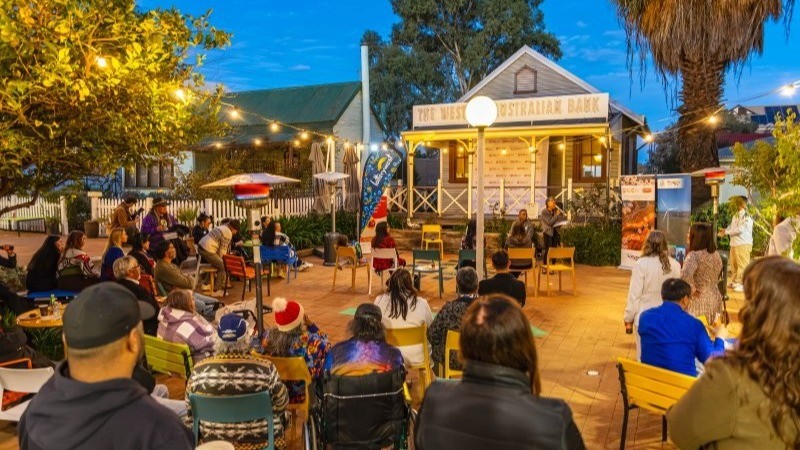
The Goldfields Aboriginal Business Chamber exists to connect these pieces. We are the local hub for collaboration, knowledge, growth and empowerment for Aboriginal businesses in our region.
In practice, that means:
- Bringing people together, so Aboriginal businesses, Traditional Owner groups, government buyers and industry meet face to face
- Building capability, through resources, mentoring and opportunities that help businesses become contract-ready
- Making Aboriginal business visible, so buyers know who is here and what they can deliver
- Backing genuine partnerships, with members who include Aboriginal-owned businesses and the allies who stand alongside them
Community is at the centre of all of it. Every contract won and every person trained flows back into families, culture and Country.
Recently we hosted First Nations business leaders from British Columbia and the Yukon, a reminder that Indigenous enterprise connects us locally and globally.
Local, connected and growing
The policies are in place, the land rights are recognised, and the businesses are ready. What turns that into lasting wealth is connection.
If you are an Aboriginal business owner, come and be part of the network. If you are a buyer, a contractor or an industry partner, talk to us about how you can work with Aboriginal businesses in the Goldfields, properly and for the long term.
This Indigenous Business Month, let's do more than celebrate. Let's build.
Find out how to join at gab.org.au/join-gabc.
Rebecca Warren is the Chief Executive Officer of the Goldfields Aboriginal Business Chamber.